

How a Heat Pump Moves Heat — and Why It Matters for Your Home
How does a heat pump work is one of the most common questions homeowners ask when exploring smarter ways to heat and cool their homes — and for good reason. Unlike a furnace that burns fuel to create heat, a heat pump simply moves heat from one place to another. In winter, it pulls heat from outdoor air and transfers it inside. In summer, it reverses that process, pushing indoor heat outside to cool your home. One system, two functions, and a fraction of the energy of traditional heating.
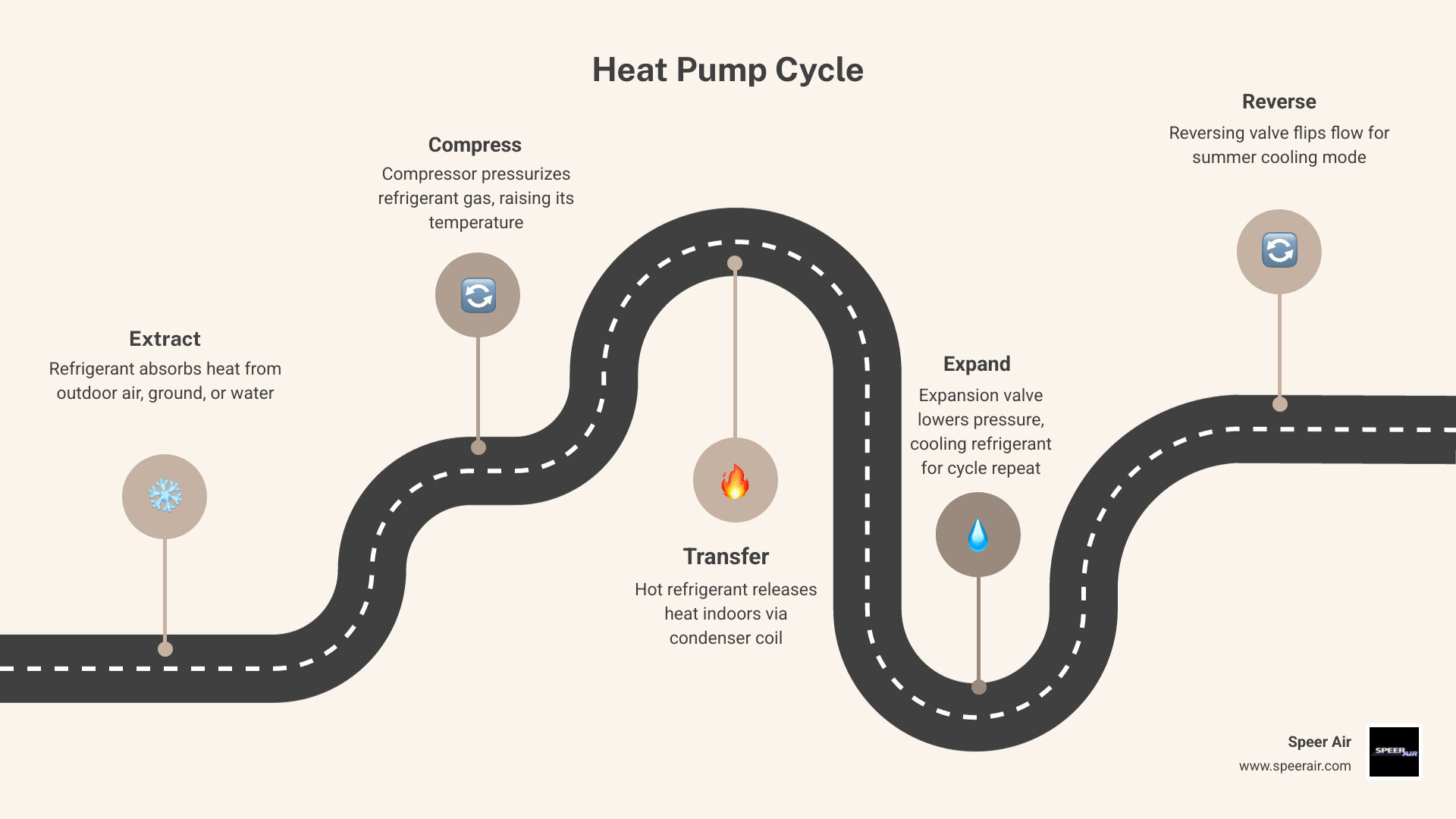
Here is a quick breakdown:
- Extract — The refrigerant absorbs heat energy from an outdoor source (air, ground, or water)
- Compress — The compressor raises the refrigerant’s temperature and pressure
- Transfer — The heated refrigerant releases warmth inside your home
- Expand — The refrigerant cools down, returns outside, and the cycle repeats
- Reverse — In summer, a reversing valve flips the direction for cooling mode
For Northern New Jersey homeowners weighing their HVAC options, understanding this process is the first step to making a confident, energy-smart decision.
What is a Heat Pump and How Does a Heat Pump Work?
To understand the “magic” of a heat pump, we first have to look at a fundamental rule of thermodynamics: heat naturally flows from a high-temperature area to a lower-temperature area. A heat pump uses a small amount of mechanical energy to reverse this natural flow, “pumping” heat uphill from a cold space to a warm one.
The secret weapon in this process is refrigerant. This special fluid has a very low boiling point, allowing it to change from a liquid to a gas even in freezing temperatures. When the refrigerant undergoes a phase change (evaporating into a gas), it absorbs a massive amount of “latent heat.” Conversely, when it condenses back into a liquid, it releases that stored energy.
Physically, heat energy is present in any environment where the temperature is above absolute zero (-273°C or -459°F). This means that even on a chilly January night in Morris County, NJ, there is still plenty of thermal energy in the outdoor air for a heat pump to harvest. By manipulating the pressure of the refrigerant, the system can make the fluid colder than the outdoor air to absorb heat, and then hotter than the indoor air to release it.
Because these systems move existing heat rather than burning fossil fuels to create it, they are incredibly efficient. In fact, for every 1 kWh of electricity used, a heat pump can transfer between 1 to 4.5 kWh of thermal energy into a building. This makes them a cornerstone of modern carbon footprint reduction efforts.

The Core Components Powering the Refrigerant Cycle
A heat pump isn’t just one machine; it’s a synchronized team of components working in a closed loop. If you’ve ever wondered why your unit makes certain clicks or hums, it’s usually these parts doing their jobs. If those sounds ever turn into clanks or squeals, you may need to resolve unusual heat pump sounds with a professional inspection.
Here are the heavy hitters in the vapor-compression cycle:
- The Evaporator Coil: Located outdoors during the winter, this is where the cold, liquid refrigerant meets the “warm” (relatively speaking) outdoor air. The refrigerant absorbs the heat and evaporates into a low-pressure gas.
- The Compressor: This is the heart of the system. It takes that low-pressure gas and squeezes it tightly. Increasing the pressure causes the temperature to spike significantly, turning it into a hot, high-pressure vapor.
- The Condenser Coil: Located indoors during winter, this coil allows the hot gas to release its heat into your home’s air. As it loses heat, the refrigerant condenses back into a high-pressure liquid.
- The Expansion Valve: This component acts like a nozzle on a spray bottle. It quickly drops the pressure of the liquid refrigerant, which causes its temperature to plummet, preparing it to head back outside and start the cycle over.
- The Reversing Valve: This is the “magic” switch. It allows the heat pump to change the direction of the refrigerant flow, effectively turning the heater into an air conditioner and vice versa.
How Does a Heat Pump Work to Provide Heating?
In heating mode, the outdoor unit acts as the heat source. Even when it feels freezing to us, the refrigerant inside the evaporator coil is even colder. As outdoor air is blown over these coils, the refrigerant “soaks up” the thermal energy and turns into a gas.
This gas travels to the compressor, where it is pressurized until it is hot enough to warm a house. This hot gas then moves to the indoor air handler. A fan blows your home’s air across the heated coils, distributing warmth through your ductwork.
Modern “cold climate” heat pumps are specifically engineered for regions like Northern New Jersey and Northeastern Pennsylvania. These units use variable-speed compressors to maintain high efficiency even when temperatures drop below 0°F. Because these systems are more complex than a standard furnace, it is common to encounter specific repair issues if the system isn’t maintained, but for most homeowners, the benefits of installation—including lower energy bills and a smaller carbon footprint—far outweigh the maintenance requirements.
How Does a Heat Pump Work to Provide Cooling?
When summer hits Essex or Somerset County, the reversing valve flips. Now, the heat pump functions exactly like a high-efficiency air conditioner.
Instead of pulling heat from the outside, the indoor coil becomes the “evaporator.” It absorbs the unwanted heat from your living room and kitchen. As the refrigerant absorbs this thermal energy, it also removes moisture from the air, providing essential indoor dehumidification.
The heat is then carried through the refrigerant lines to the outdoor unit (which now acts as the condenser), where it is rejected into the surrounding air. This ability to provide year-round comfort with a single piece of equipment allows you to transform your home into a model of modern efficiency.
Exploring Different Types: Air, Ground, and Water Sources
While the basic mechanics remain the same, heat pumps can be categorized by where they “find” their heat. Choosing the right one depends on your property size, local climate, and existing infrastructure.
- Air-Source Heat Pumps (ASHP): The most common type found in NJ and PA. They are easy to install and use the ambient outdoor air as the heat source or sink.
- Ground-Source (Geothermal) Systems: These use the stable temperature of the earth (usually about 55°F) via a series of underground pipes. While the initial setup is more involved, they offer the highest efficiency because the ground temperature doesn’t fluctuate like the air does.
- Water-Source Loops: These extract heat from a nearby body of water, such as a lake or well. These are highly efficient but require a specific set of geographic conditions.
- Hybrid (Dual-Fuel) Configurations: In many of our local service areas, we recommend a hybrid system. This combines an electric heat pump with a gas furnace. The heat pump handles the bulk of the work, but when temperatures drop into extreme negatives, the furnace kicks in to provide a boost of intense heat.
| Feature | Air-Source (ASHP) | Ground-Source (Geothermal) | Hybrid (Dual-Fuel) |
|---|---|---|---|
| Heat Source | Ambient Air | Earth / Soil | Air + Natural Gas/Propane |
| Efficiency | High (COP 2-4) | Very High (COP 3-6) | Optimized for all temps |
| Installation | Simplified | Extensive (Drilling/Trenching) | Moderate |
| Best For | Most residential homes | Large lots / New builds | Areas with extreme winters |
Properly sizing your heat pump is critical for any of these types. A unit that is too small will run constantly, while one that is too large will “short cycle,” leading to uneven temperatures and premature wear.
Measuring Efficiency: COP, SEER2, and HSPF2
When shopping for a heat pump, you’ll encounter several acronyms that describe how much “bang for your buck” you’re getting.
- COP (Coefficient of Performance): This is a snapshot of efficiency at a specific temperature. A COP of 4 means the system produces 4 units of heat for every 1 unit of electricity it consumes.
- SEER2 (Seasonal Energy Efficiency Ratio): This measures cooling efficiency over an entire season. In our region, a SEER2 of 16 to 18 is considered very efficient, with some high-end models reaching 20+.
- HSPF2 (Heating Seasonal Performance Factor): This measures heating efficiency over the winter. A higher HSPF2 means the system is better at extracting heat from cold air without relying on expensive backup “heat strips.”
Look for the Energy Star label, which identifies units that meet strict EPA criteria for efficiency. High-efficiency units not only save you money on monthly utilities but often qualify for federal tax credits and local NJ/PA rebates. If your system seems to be running longer than usual or your bills are spiking, it could be a sign of common repair issues like low refrigerant or a failing sensor, which can tank your efficiency ratings.
Frequently Asked Questions about Heat Pump Mechanics
Can a heat pump work in freezing temperatures?
Yes! Modern technology has come a long way. While older models struggled below 35°F, today’s “cold climate” heat pumps can operate efficiently at temperatures as low as -13°F or even -22°F. In Northern NJ, where we occasionally see extreme cold, many homeowners opt for a hybrid system to ensure total peace of mind.
Do heat pumps bring outside air into the house?
No. This is a common misconception. Heat pumps transfer heat energy, not the air itself. The air inside your home is recirculated through a filter and over the indoor coils. The only thing moving between the indoor and outdoor units is the refrigerant inside sealed copper lines.
How long do heat pump systems typically last?
On average, a well-maintained heat pump lasts between 10 to 20 years. Because they work year-round (both heating and cooling), they experience more “mileage” than a standalone furnace. Regular professional maintenance twice a year is the best way to ensure your system reaches the two-decade mark.
Conclusion
Understanding how does a heat pump work reveals that these systems aren’t just an alternative to traditional HVAC—they are a superior, more efficient way to manage home comfort. By moving heat instead of creating it, you can enjoy a cozy home in the winter and a crisp, dry environment in the summer, all while lowering your environmental impact.
At Speer Air, we’ve been serving the heating and cooling needs of Northern New Jersey and Northeastern Pennsylvania since 1900. As a Carrier Factory Authorized Dealer with NATE-certified technicians, we have the deep industry roots and technical expertise to help you choose, install, and maintain the perfect heat pump for your home. Whether you are in Rockaway, NJ, or Easton, PA, we are here to ensure your system runs at peak performance for years to come.
Ready to upgrade your home’s efficiency? Explore our heat pump services in Rockaway, NJ and across our entire service area to get started.