

The Unique HVAC Demands of Northern New Jersey
How northern new jersey climate affects your hvac system is a crucial topic for every homeowner in the Garden State. Northern New Jersey experiences a wide range of weather conditions, from hot, humid summers to very cold, snowy winters. Our climate often features unpredictable temperature swings and increased extreme weather events. This constant variability places immense stress on heating, ventilation, and air conditioning (HVAC) systems year-round. Your HVAC unit works tirelessly to keep your home comfortable, battling high humidity, freezing temperatures, and intense heat. Understanding these specific regional challenges is key to maintaining an efficient system, avoiding costly breakdowns, and ensuring comfortable living. For homeowners in Rockaway, NJ, effective HVAC service is not just a convenience, but a necessity.
To learn more about optimizing your home’s comfort, visit our HVAC Learning Center or schedule your Rockaway, NJ HVAC service today.
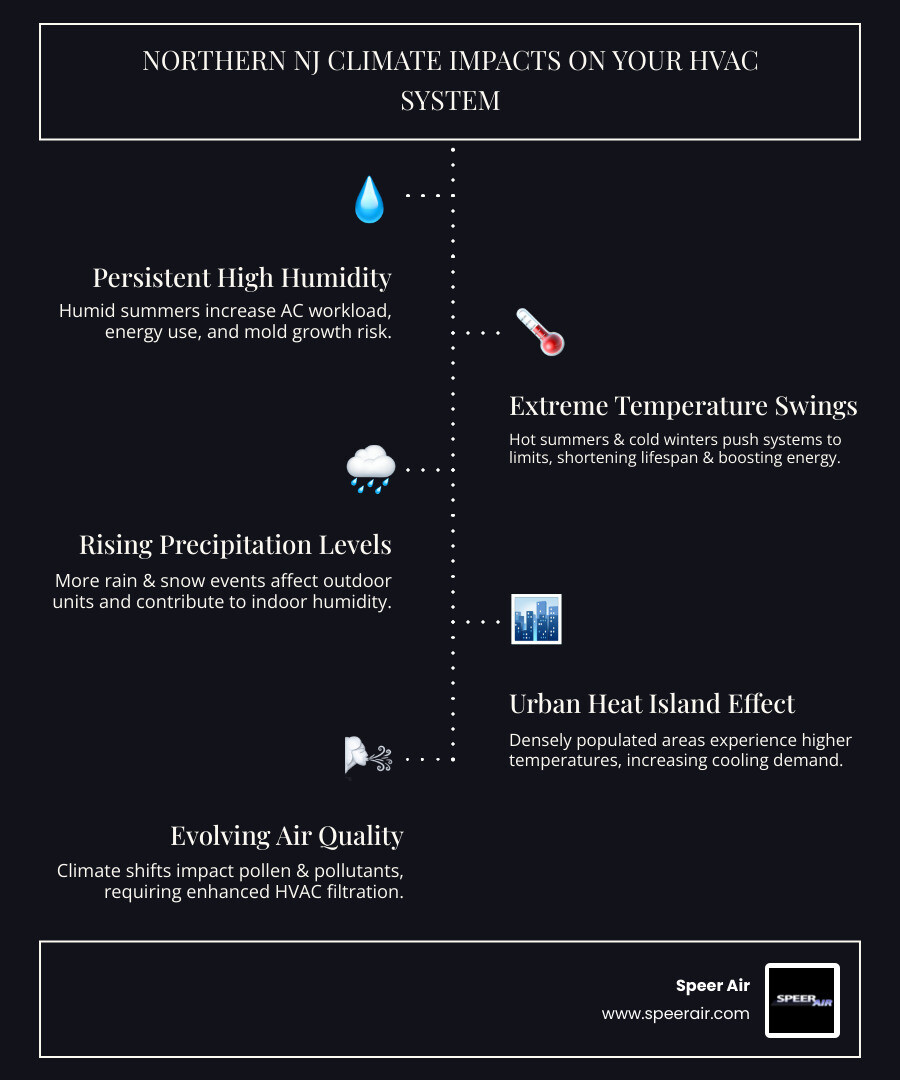
Northern New Jersey’s climate significantly impacts your HVAC system in several ways:
- High Humidity: Humid summers make AC units work harder to remove moisture. This increases energy use and the risk of mold growth.
- Extreme Temperatures: Very cold winters and increasingly hot summers push heating and cooling systems to their limits. This shortens their lifespan and boosts energy use.
- Increased Precipitation: More extreme rain and snow events can affect outdoor units. They also contribute to humidity levels, stressing systems.
- Urban Heat Islands: Densely populated areas can have much higher surface temperatures. This greatly increases cooling demand.
- Air Quality Changes: Climate shifts impact pollen counts and outdoor pollutants. This means better HVAC filtration is needed for good indoor air quality.
- Coastal Concerns: Homes near the coast face faster corrosion due to salt air. This harms outdoor unit components.
How Northern New Jersey Climate Affects Your HVAC System: The Humidity Factor
When we talk about how northern new jersey climate affects your hvac system, humidity is often the silent culprit behind high utility bills and indoor discomfort. Our region sits in a transition zone between humid subtropical and humid continental climates. This means our summers aren’t just hot; they are “soupy.”

Your air conditioner has two jobs: lowering the air temperature (sensible cooling) and removing moisture (latent cooling). In Northern New Jersey, the latent load is massive. When the air is saturated with water, your AC evaporator coil must work overtime to condense that vapor into liquid and drain it away. If you’ve ever wondered, Why is my AC not cooling my Rockaway home?, the answer often lies in the system’s inability to keep up with this moisture.
High humidity doesn’t just make you feel sticky; it creates a breeding ground for biological growth. Moisture trapped in ductwork or sitting in a clogged drain pan can lead to mold and mildew, which directly compromises your indoor air quality in Rockaway, NJ.
Managing Latent Heat and Mold Risks
To effectively manage the “Northeast swelter,” your system needs to run long enough to dehumidify the air. A common issue we see in Morris and Essex counties is “short-cycling.” This happens when an AC unit is oversized; it cools the air so fast that it shuts off before it can remove the humidity. You’re left with a home that is 72 degrees but feels like a rainforest.
Proper drainage is also vital. In our humid climate, an AC unit can pull gallons of water out of the air every day. If your condensate line is clogged, that water backs up, potentially causing property damage and sparking mold growth. If your system is acting up, our HVAC troubleshooter can help you identify if a drainage or humidity issue is at play.
Coastal Corrosion and SEER2 Standards
For our neighbors in the eastern parts of Bergen, Hudson, and Union counties, the salt air from the coast adds another layer of complexity. Salt is highly corrosive to the delicate aluminum fins and copper tubing of an outdoor condenser. Without specialized coatings or regular rinsing, a coastal HVAC system might only last half as long as one located further inland in Warren or Sussex counties.
The Department of Energy (DOE) recognizes these regional challenges. As of 2023, the northern region (which includes New Jersey) requires a minimum SEER2 rating of 13.4 (equivalent to the old SEER 14.0). These standards ensure that new installations are efficient enough to handle our specific climate demands. If your unit is struggling to meet these modern standards, it might be one of the signs your HVAC system is ready for an upgrade.
Winter Extremes and the Rise of Cold Climate Heat Pumps
While our summers are getting steamier, our winters remain a formidable challenge. Statistics show that New Jersey has warmed by about 3.5°F over the last 125 years, with winter temperatures specifically rising by 5.1°F since 1896. While “warmer” winters might sound easier on a heater, they actually bring more “freeze-thaw” cycles. This means your outdoor unit might be pelted with rain that freezes into ice an hour later, encasing your equipment in a literal block of ice.
In the past, many New Jerseyans avoided heat pumps because they struggled when temperatures dipped below freezing. However, the technology has changed. Modern cold climate heat pumps are now a top-tier choice for our region.
| Feature | Traditional Furnace | Cold Climate Heat Pump |
|---|---|---|
| Fuel Source | Natural Gas / Oil / Propane | Electricity |
| Efficiency | Up to 98% AFUE | Up to 300% (3 units of heat per 1 unit of electricity) |
| Cold Weather Performance | Excellent in all temps | Efficient down to -13°F or lower |
| Dual Functionality | Heating only | Heating and Cooling |
If you are weighing your options, understanding heat pumps a guide can help you see why these systems are becoming the standard in the Garden State. But before the first snowflake falls, you must ask: is your heating system ready for winter?
How Northern New Jersey Climate Affects Your HVAC System in Winter
The “Heating Degree Days” (HDD) in areas like Newark average around 4,800 per year. This is a measurement of how much and for how long the outside air temperature was below 65°F. In the northernmost reaches of Sussex and Warren counties, winter design temperatures can drop as low as 10°F.
To survive these dips, modern heat pumps use advanced variable-speed compressors. Unlike older models that were either “on” or “off,” these units can ramp up or down to maintain a steady temperature. They also feature sophisticated defrost cycles that use a small amount of heat to melt ice off the outdoor coils, ensuring the system doesn’t choke during a blizzard. Preparing your heating system for winter is the best way to ensure these components are ready for the stress.
Efficiency in Sub-Zero Conditions
“Hyper-heating” technology has revolutionized how we stay warm. These systems can maintain 100% of their heating capacity even when it’s 5°F outside. While some homeowners still choose to keep a gas furnace as a “backup heat” source for those rare nights when it drops to -10°F, many are finding they can transform their home with heat pump technology and rely on electricity year-round. This move often results in significant energy savings and a smaller carbon footprint.
Urban Heat Islands and Rising Summer Demands
Northern New Jersey is one of the most densely populated regions in the country. From Jersey City to Paterson and even into the suburban hubs of Morris County, we deal with the “Urban Heat Island” effect. Asphalt, brick, and concrete absorb heat during the day and radiate it back at night. Satellite data shows that land surface temperatures in these areas can reach a scorching 113°F to 162°F in the summer.
This means your AC never gets a “break.” Even when the sun goes down, the ambient air stays hot, forcing your compressor to run 24/7. The number of days over 90°F in New Jersey has increased by roughly 36% since 1949. We used to average about 14 such days per year; now, we regularly see 23 to 29 days of extreme heat. You can find more data on these trends in our HVAC learning center.
Impact of Heat Waves on System Lifespan
Constant operation during a heat wave leads to significant thermal stress. When a system runs non-stop, refrigerant levels can fluctuate, and electrical components like capacitors are more likely to fail. This increased demand doesn’t just raise your bill; it literally shaves years off your unit’s life. A system that might last 20 years in a milder climate might only last 12 to 15 years here. Accessing HVAC resources in Rockaway, NJ can help you stay ahead of these maintenance needs before a heat wave turns into a cooling emergency.
Indoor Air Quality and Grid Reliability in a Changing Climate
The climate isn’t just about temperature; it’s about what’s in the air. New Jersey has seen a 7.9% increase in annual precipitation recently, but more importantly, extreme precipitation events are up 71% over the last 50 years. These heavy storms can lead to damp basements and crawlspaces, sending musty air and mold spores upward into your living space.
Furthermore, changing weather patterns have extended our pollen seasons and increased the frequency of wildfire smoke drifting into the Northeast. When the outdoor air is hazardous, your HVAC system is your primary line of defense.
How Northern New Jersey Climate Affects Your HVAC System Filtration
Standard 1-inch fiberglass filters aren’t enough anymore. To protect your family, you need high-efficiency filtration. We recommend looking at MERV (Minimum Efficiency Reporting Value) ratings. A filter with a MERV 11 or 13 rating can trap much smaller particles, including viruses, smoke, and fine allergens.
For the ultimate protection, consider these IAQ accessories:
- HEPA Filtration: The gold standard for trapping 99.97% of particles.
- UV Germicidal Lights: These sit inside your air handler and kill mold and bacteria on the coil.
- Whole-Home Dehumidifiers: These work with your HVAC to pull moisture out of the air even when the AC isn’t running.
- Energy Recovery Ventilators (ERVs): These bring in fresh outdoor air while “pre-conditioning” it so you don’t lose energy.
Improving your indoor air quality in Rockaway, NJ is about more than just comfort—it’s about health.
Finally, we must consider grid reliability. During intense heat waves, the New Jersey power grid faces immense stress. We’ve all experienced the “brownouts” or blackouts that happen when everyone’s AC is cranked to the max. This is why many Northern New Jersey homeowners are opting for whole-home standby generators. They ensure that even if the grid fails, your HVAC system—and your comfort—remains intact.
Frequently Asked Questions about New Jersey HVAC
What is the minimum SEER2 rating required for New Jersey homes?
As of January 1, 2023, the U.S. Department of Energy requires all new central air conditioning systems installed in the Northern region, including New Jersey, to meet a minimum efficiency of 13.4 SEER2. This is roughly equivalent to the old 14.0 SEER rating. Choosing a higher rating can lead to even greater energy savings over the life of the unit.
How does high humidity impact my air conditioner’s efficiency?
Humidity forces your AC to perform “latent cooling,” which is the energy-intensive process of turning water vapor into liquid. When humidity is high, your system has to run longer and consume more electricity to achieve the same feeling of comfort. If the system is not properly maintained, this extra moisture can also lead to ice buildup on the coils, further reducing efficiency.
Can heat pumps really handle Northern New Jersey’s coldest nights?
Yes! Modern cold climate heat pumps are specifically engineered for regions like ours. While older models struggled below 32°F, today’s units feature “hyper-heating” or “Inverter” technology that allows them to provide efficient heat even when outdoor temperatures drop well below zero. For added peace of mind, many homeowners pair them with a small electric or gas backup heat source.
Conclusion
Navigating the complexities of how northern new jersey climate affects your hvac system requires local expertise and a proactive approach. From the salt-laden air of our coastal towns to the urban heat islands and the freezing winters of the highlands, our environment demands a lot from our mechanical systems.
At Speer Air, we have been a part of the Northern New Jersey community since 1900. With over a century of experience, we’ve seen every weather trend the Garden State can throw at us. Our NATE-certified technicians are experts in both residential and commercial HVAC and generator services. As a Carrier Factory Authorized Dealer and a Generac® Dealer, we provide the most reliable technology to keep your home safe and comfortable regardless of the forecast.
Don’t wait for the next extreme weather event to test your system’s limits. Explore our HVAC resources in Rockaway, NJ to stay informed, and when you’re ready for professional care, schedule your Northern New Jersey HVAC service today. Let us help you find the perfect balance of efficiency, comfort, and reliability for your home.