

Why Proper Airflow Is the Heart of Your AC’s Performance in Rockaway, NJ
How airflow affects your air conditioners performance comes down to one simple idea: your AC can only cool your home as well as air can move through it. When airflow is strong and balanced, your system transfers heat efficiently, controls humidity, and keeps every room comfortable. When airflow is restricted, everything suffers — from your energy bills to the lifespan of your equipment.
For homeowners in Rockaway and across Northern New Jersey, where summer heat and humidity can push AC systems hard, airflow problems are one of the most common — and most overlooked — reasons a system underperforms.
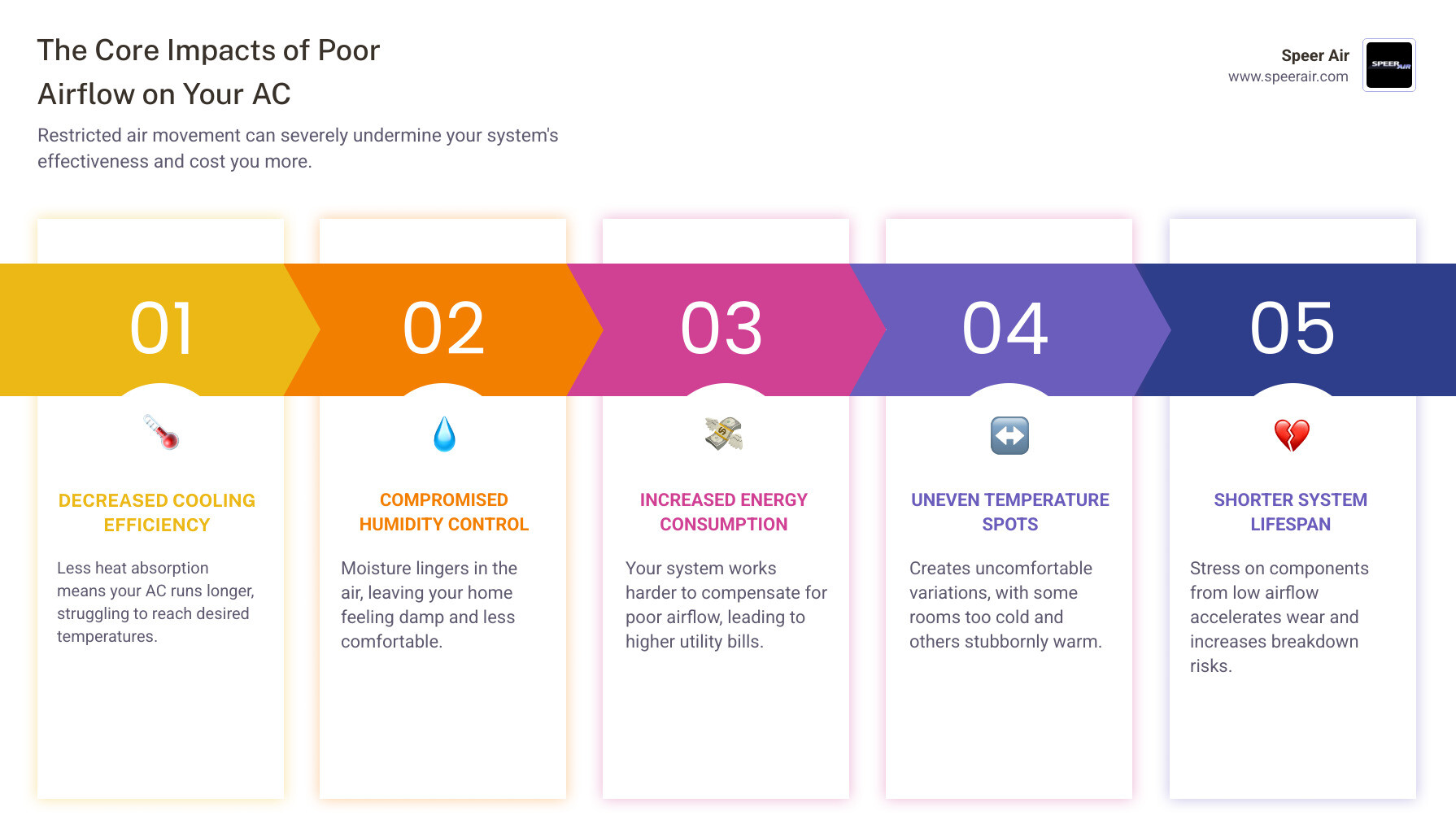
Here is a quick breakdown of how airflow directly impacts your AC:
- Cooling efficiency — Restricted airflow reduces how much heat the evaporator coil can absorb, making your system work longer to reach the same temperature
- Humidity control — Poor airflow means moisture lingers in the air, leaving your home feeling damp even when the AC is running
- Energy bills — A system fighting restricted airflow draws more power, running longer cycles to compensate
- Equipment health — Low airflow causes stress on the blower motor, can freeze the evaporator coil, and accelerates wear on major components
- Even temperature distribution — Without proper airflow, some rooms stay cool while others feel stuffy and warm
- System lifespan — Chronic airflow problems force components to work beyond their design limits, shortening the life of your entire system
Why is my AC not cooling evenly? How airflow affects your air conditioners performance in Rockaway
Have you ever noticed that your living room feels like an icebox while your upstairs bedroom feels like a sauna? This inconsistency is a classic sign of an airflow imbalance. At Speer Air, we often see homeowners in Morris County lowering their thermostats to 68 degrees just to get a stubborn bedroom down to 72. This doesn’t just waste energy; it puts incredible strain on your system.
To understand how airflow affects your air conditioners performance, consider the following comparison:
| Performance Factor | Optimal Airflow (350–450 CFM/Ton) | Restricted Airflow (<300 CFM/Ton) |
|---|---|---|
| Heat Transfer | Maximum heat absorption from indoor air | Poor heat exchange; air stays warm |
| Energy Bills | Predictable, efficient operation | High; system runs 20-40% longer |
| Indoor Humidity | Balanced moisture removal | High; home feels “muggy” or “clammy” |
| Component Stress | Low; parts operate within design specs | High; risk of motor burnout and frozen coils |
| System Lifespan | 15–20 years with maintenance | 10–12 years due to excessive wear |
When air cannot move freely, the heat transfer process breaks down. Your AC doesn’t “create” cold; it removes heat. If there isn’t enough air passing over the cold evaporator coils, that heat stays in your house. This leads to uneven cooling at home and can cause your unit to cycle on and off rapidly. If you notice your system starting and stopping every few minutes, you should investigate why your AC might be short cycling before it leads to a total compressor failure.
How airflow affects your air conditioners performance in humid New Jersey summers
In Northern New Jersey, we don’t just deal with heat; we deal with heavy humidity. This is where the “latent load” comes into play. Latent load refers to the energy required to remove moisture from the air.
If airflow is too fast, the air doesn’t spend enough time in contact with the cold evaporator coil to drop its moisture. If it’s too slow, the coil can get too cold and freeze. Proper airflow ensures that the air moves at the perfect velocity to wring out excess water, preventing that damp, sticky feeling inside your home. Without this balance, your indoor comfort will plummet, regardless of what the temperature reading says.
Identifying how airflow affects your air conditioners performance through weak vent output
One of the easiest ways to spot an issue is to simply place your hand near a supply vent. Do you feel a strong, steady breeze, or is it more like a faint whisper? Weak air velocity is a red flag.
When the blower motor has to fight against high pressure (caused by dirty filters or narrow ducts), it works harder and gets hotter. This creates a pressure imbalance throughout the house. Some rooms may have “dead spots” where air simply doesn’t circulate, leading to temperature pockets that make your home feel inconsistent and uncomfortable.
Common Causes of Restricted Airflow and Component Damage

Restricted airflow is rarely the result of a single catastrophic failure. Instead, it is usually a slow buildup of several smaller issues. The most common culprit is a dirty air filter. A filter’s job is to catch dust and debris, but once it’s full, it acts like a wall, forcing your blower motor to work overtime just to pull air through the system.
Other common causes include:
- Blocked Registers: Furniture, long curtains, or rugs covering your vents.
- Dirty Coils: Dust buildup on the evaporator or condenser coils acts as insulation, preventing heat transfer.
- Closed Internal Dampers: Sometimes dampers inside the ductwork are accidentally closed, cutting off air to entire sections of the house.
Choosing the right filter is vital for maintaining balance. High-MERV filters provide better air quality but can restrict airflow if your system isn’t designed for them. For help deciding, check out our guide on air filter selection for your Rockaway HVAC. If you’ve already changed your filter and still have issues, you may need help troubleshooting poor airflow from HVAC vents to find deeper obstructions.
Preventing frozen coils and blower motor failure
When airflow is restricted, the evaporator coil (the part inside your home) becomes too cold. Because there isn’t enough warm air passing over it to keep the refrigerant at the right temperature, the condensation on the coil turns to ice.
Once ice forms, it acts as a further insulator, blocking even more air. This creates a dangerous cycle that can lead to liquid refrigerant “slugging” back into your compressor, which is a death sentence for an AC unit. Additionally, the blower motor, which relies on moving air to stay cool, can overheat, leading to insulation breakdown and electrical failure. If you see ice on your unit, look into solutions for frozen evaporator coils immediately and turn the system off to let it thaw.
Simple homeowner steps for better circulation
You don’t always need a technician to improve your home’s “breathing.” Here are a few steps you can take today:
- Replace filters every 1–3 months: In homes with pets or allergies in areas like Morris or Essex County, once a month is better during peak summer.
- Clear the perimeter: Ensure there are at least two feet of clear space around your outdoor condenser unit. Remove weeds, leaves, and debris.
- Check your vents: Walk through every room and make sure no furniture or rugs are blocking the registers.
- Keep all vents open: It’s a myth that closing vents in unused rooms saves money. It actually increases pressure in the ducts and can cause leaks or motor strain.
The Technical Side: CFM per Ton and Humidity Control
In the HVAC world, we measure airflow in CFM (Cubic Feet per Minute). A standard rule of thumb for residential systems is that you need between 350 and 450 CFM per ton of cooling capacity. A 3-ton system, for example, should be moving roughly 1,200 CFM.
This volume is critical for balancing “sensible cooling” (lowering the temperature you see on the thermometer) and “latent cooling” (removing humidity). If the CFM is off, the balance is lost, and you’ll either have a house that is cool but clammy, or a system that runs forever without ever reaching the set point.
Ideal airflow rates for different climates
While 400 CFM is the nominal standard, climate plays a huge role in how we calibrate your system in Northern New Jersey and Eastern Pennsylvania.
- Humid Climates (Our Region): We often target 300–350 CFM per ton. Slower air stays on the coil longer, which is better for removing the heavy moisture we experience in July and August.
- Dry Climates: In desert regions, technicians might push 450–550 CFM per ton to move as much air as possible, since moisture removal isn’t a priority.
Professional installers use “Manual S” data from manufacturers to ensure the blower speed is matched perfectly to the local environment and the specific ductwork in your home.
What happens when airflow is too high or too low?
Too Low: As discussed, this leads to coil freezing, poor cooling, and high humidity. It also creates low air “throw,” meaning the cool air doesn’t make it across the room; it just falls out of the vent and stays near the floor.
Too High: If the airflow is too high, your AC will be incredibly noisy. You might hear whistling or a “whooshing” sound in the ducts. More importantly, the air moves so fast that it doesn’t get cold enough or dry enough. Your home might reach the target temperature quickly, but it will feel muggy and uncomfortable. This is why measuring Total External Static Pressure (TESP) is a vital part of a professional diagnostic.
How Ductwork Design and Professional Evaluation Impact Airflow
Your ductwork is the “circulatory system” of your home. Even the most expensive, high-efficiency Carrier AC unit will fail if the ducts are undersized, leaky, or poorly designed. Research shows that duct leaks can account for up to 30% of airflow loss in many homes. Imagine paying for a full gallon of milk but having 30% of it leak out of the bag before you get home—that is exactly what happens with leaky ducts.
In older homes throughout Northern New Jersey, we often find ducts that were designed for heating only. Since cool air is denser and harder to move than warm air, these old ducts often struggle to provide the necessary airflow for modern AC systems. If your home never feels quite right, you may need to consider duct installation and replacement in Rockaway to bring your system up to modern standards. Beyond performance, sealing these leaks can also enhance your home’s indoor air quality by preventing attic dust from being sucked into your living space.
When to call a professional for an airflow evaluation
If you’ve changed your filters and cleared your vents but still have issues, it’s time for a professional evaluation. You should call us if you notice:
- Weak or inconsistent airflow from vents.
- Strange HVAC noises like whistling, banging, or rattling.
- Energy bills that are significantly higher than last year.
- The AC running constantly without cooling the house.
Our NATE-certified technicians use specialized tools like manometers to perform a TESP (Total External Static Pressure) analysis. This tells us exactly how much resistance your blower motor is fighting against. It allows us to pinpoint whether the problem is a crushed duct, a dirty internal coil, or an undersized return vent.
The role of regular maintenance in preventing airflow issues
Most airflow disasters are preventable. During an annual tune-up, a Speer Air technician does more than just “check” the system. We clean the blower wheel (where even a thin layer of dust can reduce efficiency by 15%), inspect the evaporator and condenser coils for buildup, and verify that the system is commissioned to the correct CFM for your home’s size and layout. This proactive approach ensures that your system “breathes” easily all summer long.
Frequently Asked Questions about AC Airflow
How often should I replace my air filters in Northern New Jersey?
In our region, you should check your filter every 30 days during the summer. If you have pets, live near a busy road, or have allergies, you will likely need to replace it every month. At a minimum, never go longer than three months without a fresh filter.
Can leaky ducts really increase my energy bills by 30%?
Yes. When 30% of your conditioned air escapes into your attic or crawlspace, your AC has to run 30% longer to achieve the desired temperature in your living areas. This leads to higher utility costs and significantly more wear and tear on your compressor.
What is TESP and why does my HVAC technician measure it?
Total External Static Pressure (TESP) is essentially a “blood pressure” test for your HVAC system. It measures the resistance air faces as it moves through your filters, coils, and ducts. High TESP means your system is struggling to “breathe,” which leads to motor failure and poor cooling.
Conclusion
Understanding how airflow affects your air conditioners performance is the first step toward a more comfortable, efficient home. From the simple act of changing a filter to the technical precision of a TESP evaluation, airflow is the foundation of everything your AC does.
Since 1900, Speer Air has been the trusted name for home comfort in Northern New Jersey. As a Carrier Factory Authorized Dealer with NATE-certified technicians, we have the tools and the century-long experience to diagnose and fix even the most complex airflow challenges. Whether you are in Rockaway, Morris County, or any of our surrounding service areas, we are here to ensure your system runs at peak performance.
Don’t let poor airflow compromise your comfort this summer. Schedule professional Rockaway air conditioner service with Speer Air today and feel the difference that proper circulation makes.