

The Real Cost Difference Between Mini Splits and Central AC
The mini split vs central ac cost comparison comes down to one key variable: whether your home already has ductwork.
Here is a quick breakdown to answer the core question:
| Factor | Mini Split | Central AC |
|---|---|---|
| With existing ducts | Higher upfront cost | Lower upfront cost |
| Without existing ducts | More affordable overall | Significantly more expensive |
| Energy efficiency (SEER2) | 18-33+ | 14-21 |
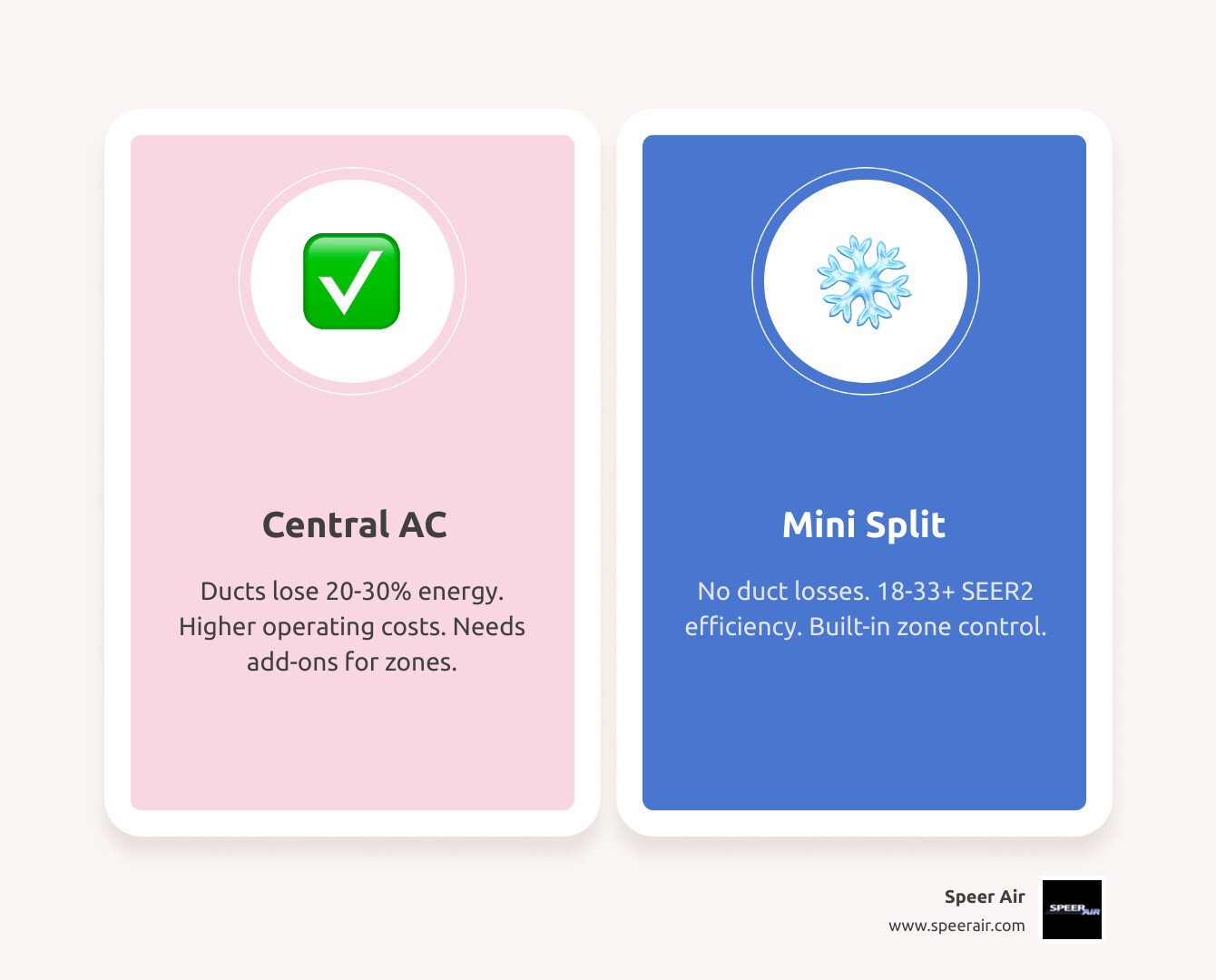
| Duct energy loss | None | 20-30% of conditioned air |
| Zone control | Built-in by default | Requires add-ons |
| Heating capability | Yes (heat pump models) | Cooling only |
| Lifespan | 15-20 years | 15-20 years |
| Long-term operating costs | Lower | Higher |
If your Northern New Jersey home already has well-maintained ductwork, central AC is usually the more budget-friendly choice upfront. If your home lacks ducts — or has older, leaky ones — a mini split system can save you thousands while delivering better efficiency.
That said, the upfront number is only part of the story. Energy losses through duct systems, zone control savings, and available tax credits can shift the math considerably over a 10-to-15-year period. According to the U.S. Department of Energy, duct leaks alone account for 20 to 30 percent of energy waste in central AC systems — a hidden cost that adds up fast on your monthly utility bill.
Whether you are cooling a 1960s ranch with cast-iron radiators or a newer colonial that already has forced air, understanding the full picture before you choose a system can save you a significant amount of money over the life of the equipment.
Upfront Installation Factors for Mini Split vs Central AC Cost Comparison
When we look at the initial investment for a new cooling system in 2026, the complexity of the installation plays a massive role. Central air conditioning has long been the “gold standard” for whole-home comfort in the United States, but the labor required to install it can vary wildly depending on your home’s skeleton.
A central AC installation typically involves a large outdoor condenser and an indoor evaporator coil often paired with a furnace. Because it relies on a single high-powered fan to push air through the entire house, the physics of the installation are rigid. On the other hand, mini splits consist of an outdoor unit connected to one or more indoor air handlers via small refrigerant lines. This “ductless” nature allows for much more flexibility in where we can place the units.
Structural modifications are often the “hidden” part of the mini split vs central ac cost comparison. For a central system, we might need to cut into ceilings or walls to fit bulky metal ducts. Mini splits only require a small three-inch hole in the exterior wall to connect the indoor and outdoor components. However, mini splits often require more specialized electrical work, as each indoor head needs to be powered and communicated with by the outdoor controller. To ensure a safe and compliant setup, our team at Speer Air focuses on high-quality HVAC Installation Services Available in Rockaway to handle these technical nuances.
Impact of Existing Ductwork on Mini Split vs Central AC Cost Comparison
Ductwork is truly the “hidden cost monster” of HVAC. If your home in Morris County or Sussex County was built with a forced-air heating system, you already have the infrastructure for central AC. In this scenario, central air is almost always the more economical choice for the initial purchase.
However, many older homes in Northern New Jersey and Eastern Pennsylvania—especially those with historic plaster walls or hydronic (radiator) heating—lack ducts entirely. Retrofitting a 2,000-square-foot home with new ductwork is a massive undertaking. It involves demolition, loss of closet space or ceiling height, and significant carpentry repairs afterward. In these cases, the Duct Installation Replacement Rockaway NJ process can become so invasive and expensive that a multi-zone mini split system becomes the clear financial winner.
Beyond just the presence of ducts, their condition matters. If your existing ducts are leaky, uninsulated, or located in a sweltering attic, they could be wasting nearly a third of your cooling energy. Before deciding, it is wise to Enhance Your Home’s IAQ with Duct Installation or at least have your existing system tested for leakage.
Multi-Zone Flexibility and Mini Split vs Central AC Cost Comparison
One of the most significant advantages of going ductless is “zoning by default.” A central AC system is usually “all or nothing”—when the thermostat clicks on, the whole house gets cooled, regardless of whether you are using the guest bedroom or the basement.
Mini splits use individual indoor air handlers for different areas of the home. This allows you to turn off the cooling in the kitchen at night while keeping the master bedroom at a crisp 68 degrees. This targeted comfort is why we often recommend Ductless HVAC Services Rockaway NJ for room additions, converted garages, or sunrooms.
While adding more “zones” to a mini split system increases the equipment price, it offers a level of control that central AC can only mimic with expensive motorized dampers and complex bypass ducting. By Understanding Ductless Mini-Split Systems, homeowners can see how spending a bit more on a multi-zone setup today can lead to much lower bills tomorrow.
Long-Term Operating Costs and Energy Efficiency
In 2026, efficiency is measured by SEER2 (Seasonal Energy Efficiency Ratio 2) and HSPF2 (Heating Seasonal Performance Factor 2). These updated standards reflect real-world conditions more accurately than the old ratings. When performing a mini split vs central ac cost comparison, the efficiency gap is where the mini split truly shines.
Most modern mini splits utilize inverter technology. Unlike a standard central AC compressor that is either 100% “on” or 100% “off,” an inverter compressor acts like a dimmer switch. It ramps up and down to match the exact cooling load of the room. This prevents the energy-intensive “startup spikes” that happen every time a central AC kicks on. You can use a SEER Calculator to see how these higher ratings translate into monthly savings.
| System Type | Typical SEER2 Range | Energy Waste Factor |
|---|---|---|
| Standard Central AC | 14 – 17 | High (Duct Loss) |
| High-Efficiency Central AC | 18 – 21 | Moderate (Duct Loss) |
| Ductless Mini Split | 18 – 30+ | Zero (No Ducts) |
Duct leakage is the primary enemy of central AC efficiency. Even a “well-installed” duct system often loses 20% of its air to the attic or crawlspace. Mini splits eliminate this entirely because the cooling happens right at the indoor unit. For those looking at Choosing the Right AC System: Factors to Consider, it is important to remember that a SEER 16 mini split can often outperform a SEER 20 central AC in real-world electricity usage simply because it doesn’t have to fight leaky ducts.
Furthermore, most mini splits are actually heat pumps. They don’t just cool; they can provide highly efficient heating during our chilly New Jersey winters. By Understanding Heat Pumps: A Guide, you’ll discover that these systems can often replace both an old AC and a noisy furnace, consolidating your energy costs into one highly efficient bill.
Maintenance, Lifespan, and Total Cost of Ownership
Every HVAC system requires love and attention to reach its full potential. For central air, maintenance usually focuses on the outdoor condenser and the indoor coil, along with changing a single large filter every few months. However, central systems also require periodic duct cleaning and sealing to maintain air quality and efficiency.
Mini splits require a different approach. Because they have indoor units in multiple rooms, there are more filters to clean—usually every two to four weeks during heavy use. These filters are reusable, which saves money, but the homeowner must be diligent. If the indoor blower wheels get dirty, they can become a breeding ground for mold, requiring a professional deep clean.
In terms of longevity, both systems typically last between 15 and 20 years if maintained properly. Central AC systems are familiar to almost every technician, making repairs straightforward. Mini splits are more “high-tech,” relying on complex printed circuit boards (PCBs) that can be more expensive to replace if damaged by a power surge.
When we calculate the 15-year Total Cost of Ownership (TCO), mini splits often come out ahead despite a potentially higher starting price for multi-zone setups. The 30% to 50% energy savings every month eventually pay back the initial investment. If you are seeing Signs HVAC System is Ready for an Upgrade, considering the TCO rather than just the “sticker price” is the smartest way to shop for an Air Conditioner Rockaway.
Financial Incentives: Tax Credits and Rebates
One of the biggest shifts in the 2026 mini split vs central ac cost comparison is the availability of federal and local incentives. Under the Inflation Reduction Act, qualifying high-efficiency heat pumps (which includes most premium mini splits) can qualify for a federal tax credit of up to $2,000 per year. In contrast, standard central AC units are often capped at a much lower $600 credit.
Many utility companies in New Jersey and Pennsylvania also offer localized rebates for switching to Energy Star-certified equipment. These rebates can sometimes reach over $1,000, significantly narrowing the gap between system types. We always encourage our clients to check our HVAC Promotions Rockaway NJ page to stay updated on the latest seasonal offers.
If the upfront cost is still a hurdle, HVAC Financing Rockaway NJ options can help spread the investment over several years, allowing the monthly energy savings to help offset the payment.
Frequently Asked Questions about Mini Split vs Central AC
Which system is better for an older home without ducts?
For older homes in areas like Easton, PA or Morristown, NJ, mini splits are almost always the superior choice. Installing central AC in a home with plaster walls and no attic access often requires “dropping” ceilings or building unsightly soffits to hide ductwork. This not only ruins the historic charm of the home but also adds a massive amount of labor and material cost.
Mini splits offer a “non-invasive” installation. We only need to run a small line set through a closet or along the exterior of the house. This preserves the structural integrity and aesthetic of the home while providing modern, Ductless HVAC Services Rockaway NJ that older homes desperately need.
How does adding heating capability affect the overall value?
Adding a mini split heat pump doesn’t just add cooling; it provides a redundant or primary heating source. This is a massive value-add for homes that currently rely on expensive electric baseboard heat or older oil boilers.
In 2026, buyers are looking for energy-efficient homes with “smart” features. A multi-zone heat pump system that allows for individual room control is a major selling point. By Understanding Heat Pumps: A Guide, you can see how these systems offer year-round comfort that a “cooling only” central AC simply cannot match.
What is the typical lifespan of each system?
Both systems are designed to provide 15 to 20 years of service. However, the “real” lifespan depends on the environment and maintenance. In high-humidity areas or places with lots of dust, mini split filters need more frequent attention to prevent the indoor units from overworking.
Central AC units are rugged, but their lifespan is often cut short by leaky ducts that cause the compressor to run longer cycles than intended. Regardless of which system you choose, utilizing Our HVAC Services Rockaway NJ for annual tune-ups is the best way to ensure your investment lasts for two decades.
Conclusion
Choosing between mini split and central air isn’t about which system is “better”—it’s about which system fits your home’s unique footprint and your long-term financial goals. If you have great ducts and want an invisible, whole-home solution, central AC is a fantastic choice. If you want the ultimate in energy efficiency, have a home without ducts, or want to reclaim control over your monthly utility bills, ductless is the way of the future.
At Speer Air, we have been serving Northern New Jersey and Eastern Pennsylvania since 1900. As a Carrier Factory Authorized Dealer with NATE-certified technicians, we have the expertise to help you navigate the mini split vs central ac cost comparison with honesty and precision. Whether you are in Bergen County, NJ or Stroudsburg, PA, we are here to ensure your home remains a sanctuary of comfort.
Ready to see which system is right for your budget? Contact us for a consultation on Ductless HVAC Services Rockaway NJ today.