

What Homeowners in Northern New Jersey Should Know About How Their AC Actually Cools Their Home
How your air conditioner works is simpler than most people think — and understanding it can save you money, help you spot problems early, and make better decisions about your home comfort system.
Here’s the short answer:
- Warm indoor air is pulled across a cold evaporator coil inside your home.
- Refrigerant inside that coil absorbs the heat from the air, turning from liquid into gas.
- The compressor pumps that hot gas to the outdoor unit.
- The condenser coil releases the heat outside, and the refrigerant cools back into a liquid.
- The cooled, dehumidified air is blown back into your home through your ducts or air handler.
- The cycle repeats until your thermostat’s set temperature is reached.
Your AC doesn’t create cold air. It moves heat — from inside your home to outside. Think of it like a refrigerator, but for your entire living space.
Most home air conditioners recirculate the same indoor air through this process rather than pulling in fresh air from outside. In an average-sized home, this cycle runs enough to consume over 2,000 kilowatt-hours of electricity per year — which is why efficiency and proper maintenance matter so much.
Whether you’re troubleshooting a problem, shopping for a new system, or just curious about what’s humming outside your window, knowing how your system works puts you in control.
Understanding How Your Air Conditioner Works: The Science of Heat Transfer
To truly grasp how your air conditioner works, we have to look at a bit of “magical” physics called phase conversion. This is the scientific law that states when a liquid converts into a gas, it absorbs a tremendous amount of heat. Your AC is essentially a heat-moving machine that exploits this law in an endless, elegant cycle.
In an average-sized home, air conditioning can consume more than 2,000 kilowatt-hours of electricity per year. This energy isn’t used to “create” cold; it’s used to power the pumps and fans that move heat from one place to another. If you’ve ever wondered, “Why is My AC Not Cooling My Rockaway Home?“, the answer usually lies in a breakdown of this heat transfer process.
The “sponge” that carries this heat is called refrigerant. This special fluid is designed to change from a liquid to a gas at very low temperatures. It flows through a closed loop of copper coils, traveling between your indoor and outdoor units. However, this system must remain perfectly sealed. If you encounter AC Refrigerant Leak Issues in Your Home, the “sponge” can no longer absorb heat effectively, leaving your home warm despite the system running constantly.
How Your Air Conditioner Works to Remove Humidity
Cooling your home isn’t just about lowering the temperature; it’s about making the air feel “crisp.” This is where dehumidification comes in. As warm, humid air from your living room or kitchen is blown over the freezing-cold evaporator coil, the moisture in the air reaches its dew point.
Just like a cold glass of iced tea “sweats” on a humid July afternoon in Morris County, moisture from your indoor air condenses into liquid water on the surface of the coil. This water drips into a collection pan and is funneled outside or into a floor drain. This process is why you might need help Fixing Water Leaks from Your AC Unit if that pan overflows or the drain gets stuck.
If your system is working correctly, it should leave your home feeling dry and comfortable. However, many homeowners still Deal with Excessive Humidity Despite Running AC. This can happen if the system is oversized and “short cycles” (turning off before it has time to remove enough moisture) or if there are Solutions for AC Drain Line Clogs at Home that need to be addressed to keep the water moving out of your house.
The Role of Airflow and Ductwork in How Your Air Conditioner Works
Even the most powerful AC unit is useless if the cooled air can’t reach you. This is where the blower fan and the Air Handling Unit (AHU) come into play. The AHU is the heart of your home’s air circulation. It pulls warm air from your rooms through “return” registers, pushes it through a filter and over the cooling coils, and then sends the chilled air back through the “supply” ducts.
Proper airflow is critical. If your ducts are leaky or blocked, you’ll likely need to learn How to Address Uneven Cooling at Home. Furthermore, because the AHU recirculates the same air, keeping your ductwork clean is vital for your health. If you notice a musty or “dirty sock” smell, you may need to investigate How to Eliminate Bad Odors Coming from AC to ensure your indoor air quality remains high.
The Four Stages of the Refrigeration Cycle

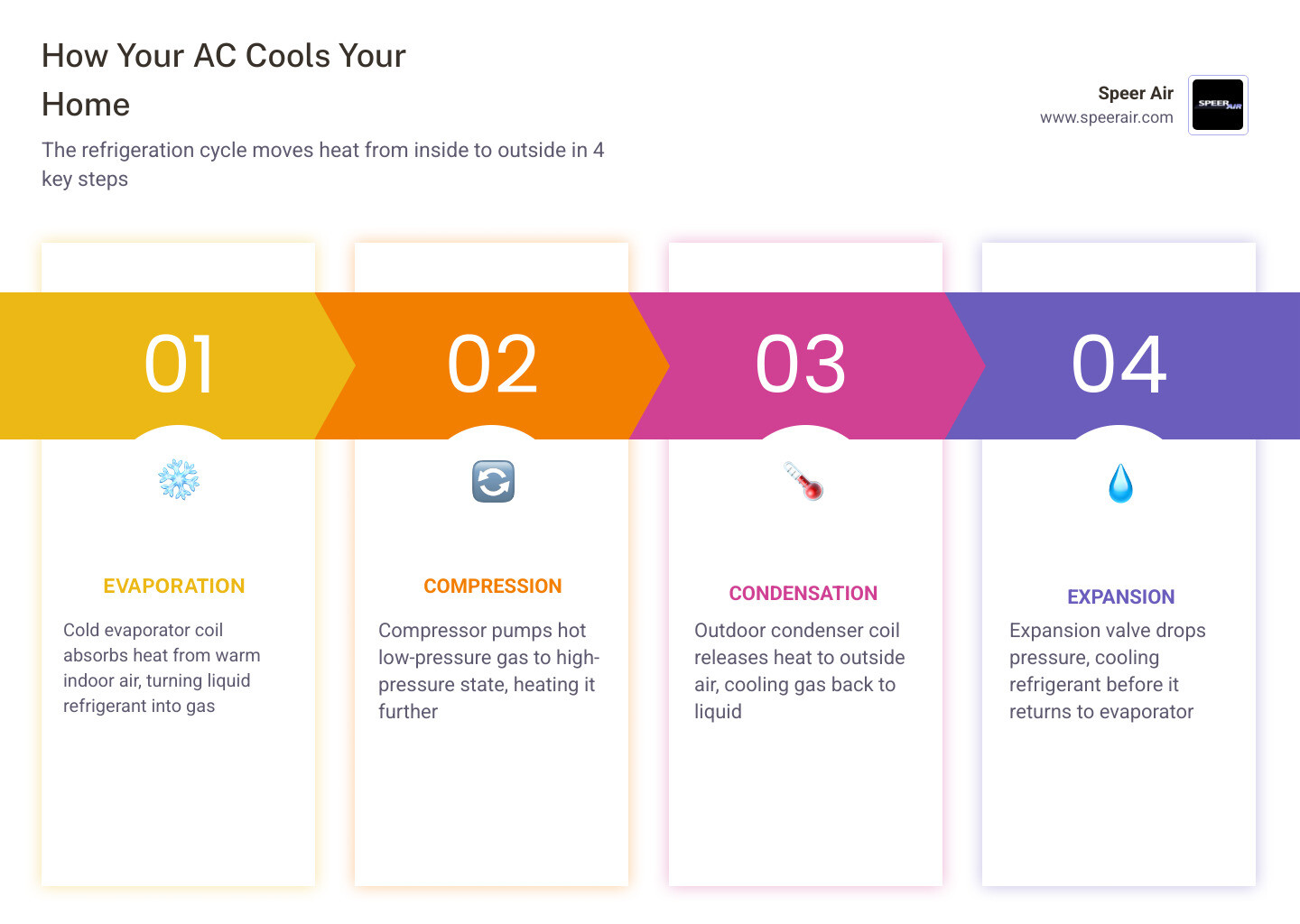
The refrigeration cycle is a continuous loop. It is a closed-loop system, meaning the refrigerant should never be “used up” or “topped off” unless there is a leak. Let’s break down the four stages that keep your New Jersey home comfortable in April 2026 and beyond.
Step 1 and 2: Evaporation and Compression
The cycle begins at the evaporator coil (the indoor unit). Cold, liquid refrigerant enters the coil. As the blower fan pushes warm indoor air across these coils, the refrigerant absorbs the heat and begins to boil, turning into a low-pressure vapor.
Once the refrigerant has “soaked up” the heat, it travels outside to the compressor. Often called the “heart” of the system, the compressor squeezes the refrigerant vapor, raising its pressure and temperature significantly. This is a heavy-duty job, which is Why AC Compressor Might Be Making Loud Noises if the internal components start to wear out. The result of this stage is a very hot, high-pressure gas.
Step 3 and 4: Condensation and Expansion
The hot gas now enters the condenser coil (the outdoor unit). A large fan pulls outdoor air across these coils. Because the refrigerant is now much hotter than the outside air, the heat naturally transfers from the coils to the outdoor environment. As it loses heat, the refrigerant condenses back into a high-pressure liquid.
Finally, the liquid refrigerant reaches the expansion valve. This component acts like a nozzle, suddenly dropping the pressure of the refrigerant. Just as a spray can feels cold when you release the contents, the refrigerant’s temperature plummets as it expands. If this process is disrupted, you might see ice forming on your unit, requiring Solutions Frozen Evaporator Coils in AC System. Now cold and ready to absorb more heat, the refrigerant heads back indoors to start the cycle all over again.
Primary Components and System Types
Not every home in Northern New Jersey uses the same setup. Depending on your home’s age and architecture, you might have one of three main types of systems.
| System Type | Best For | Key Components |
|---|---|---|
| Split-System | Homes with existing ductwork | Indoor evaporator + Outdoor condenser |
| Packaged Unit | Homes with limited indoor space | All components in one outdoor cabinet |
| Ductless Mini-Split | Older homes, additions, or zoning | Outdoor unit + Small indoor wall-mounts |
When it comes to Choosing the Right AC System: Factors to Consider, our team at Speer Air looks at your square footage, insulation levels, and whether you have existing ducts.
Central Air vs. Ductless Solutions
Central air is the gold standard for many, providing uniform cooling through a network of ducts. It relies on a large outdoor condenser and an indoor evaporator usually paired with your furnace. However, for many of our neighbors in older Morris County homes, installing ducts is either impossible or too invasive.
Ductless mini-splits have become incredibly popular as we head into 2026. These systems allow for “zoning,” meaning you can cool the master bedroom to 68 degrees while leaving the guest room at 74. Because they don’t lose energy through ductwork — which can account for up to 30% of energy loss — they are incredibly efficient. If you’re interested in these versatile systems, our Air Conditioning Services Rockaway NJ can help you design the perfect layout.
Maximizing Efficiency and Performance in 2026
In April 2026, energy efficiency is more important than ever. The industry now uses SEER2 (Seasonal Energy Efficiency Ratio) to measure how much cooling a system delivers per watt of electricity.
- Newer systems can have SEER2 ratings as high as 26.
- ENERGY STAR certified central air conditioners are roughly 15% more efficient than standard models.
- Variable-capacity systems can run at lower speeds during milder days, providing better dehumidification and quieter operation.
To keep these high-efficiency ratings intact, regular AC Maintenance Rockaway NJ is non-negotiable. A dirty coil or a clogged filter can force a high-efficiency unit to work twice as hard, negating your energy savings. If your current system is over 15 years old, a professional AC Installation Rockaway NJ could pay for itself in reduced monthly bills over the next few years.
Frequently Asked Questions about AC Operation
Does an air conditioner pull fresh air from the outside?
Contrary to popular belief, most residential air conditioners do not pull air from the outside. They are “recirculation” systems. They pull the air already inside your home, filter it, cool it, and send it back. The only thing that moves between the indoor and outdoor units is the refrigerant and the heat it carries. This is why indoor air filtration is so important; since the air is reused, you want a high-quality filter to catch dust and allergens.
Why is my air conditioner short cycling?
Short cycling is when your AC turns on and off rapidly without completing a full cooling cycle. This is often a sign of Why AC Might Be Short Cycling and How to Fix It. Common culprits include an oversized unit (which cools the air too fast but fails to remove humidity), a frozen evaporator coil, or a faulty thermostat. This puts massive strain on the compressor and should be fixed immediately to avoid a total system failure.
Why does my AC keep tripping the circuit breaker?
If your breaker trips once, it might be a fluke. If it happens repeatedly, your AC is likely drawing too much power. This could be due to an electrical overload, a failing motor, or a compressor that is “grounded” (an internal electrical fault). You should never simply reset the breaker and ignore the problem, as this can lead to a fire. Check out our guide on Why AC Might Be Tripping Your Circuit Breaker and then call for AC Repair Rockaway NJ to have a professional diagnose the electrical issue.
Conclusion
Understanding how your air conditioner works is the first step toward a more comfortable and energy-efficient home. From the complex refrigeration cycle to the simple importance of a clean air filter, every part of your system plays a role in keeping you cool during the humid New Jersey summers.
At Speer Air, we’ve been the trusted HVAC experts in Northern New Jersey since 1900. Our NATE-certified technicians have the experience to handle everything from minor repairs to complex installations. As a Carrier Factory Authorized Dealer, we provide the highest quality equipment backed by over a century of local service.
Whether you need a quick AC Repair or you’re ready to upgrade to a high-efficiency SEER2 system, we are here to help. Don’t wait for the first heatwave of the season to find out your system isn’t up to the task. Schedule your professional cooling service today and ensure your home stays an oasis of comfort all year long.