

Understanding the Central AC vs Ductless Mini Split Comparison
The central ac vs ductless mini split comparison is one of the most important decisions a New Jersey homeowner can make when upgrading or replacing a cooling system. Both systems move heat out of your home using refrigerant — but the way they deliver comfort, and what they cost to run, are very different.
Here’s a quick breakdown to help you decide:
| Factor | Central AC | Ductless Mini-Split |
|---|---|---|
| Requires ductwork | Yes | No |
| Energy efficiency (SEER2) | 13–21 | Up to 38+ |
| Zoning | Limited | Built-in, per room |
| Best for | Homes with existing ducts | Older homes, additions, no ducts |
| Heating capability | No (needs furnace) | Yes (heat pump) |
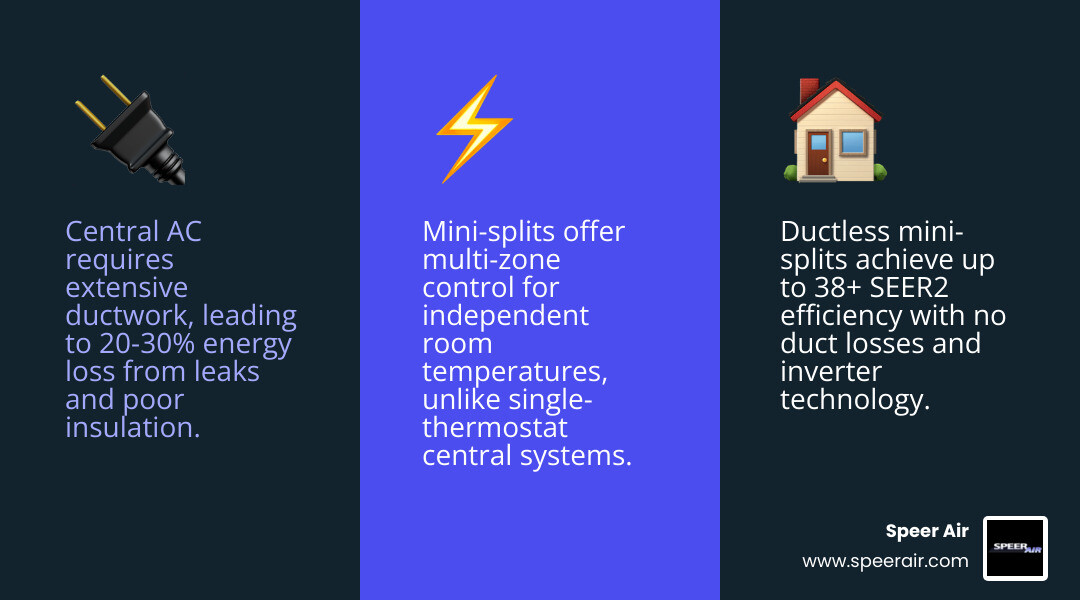
| Duct energy loss | 20–30% | None |
| Lifespan | 15–20 years | 15–20 years |
| Federal tax credit (2026) | Up to $600 | Up to $2,000 |
The single biggest factor in this decision? Your ductwork. If your home already has ducts in good shape, central AC is a strong, cost-effective choice. If you don’t have ducts — or they’re old and leaky — a ductless mini-split can deliver better efficiency, better comfort control, and lower energy bills.
New Jersey homes, especially older ones in towns like Rockaway, often weren’t built with modern duct systems. That makes this comparison especially relevant for homeowners here.
To truly master the central ac vs ductless mini split comparison, we first need to look at how these systems work under the hood. Both rely on the same scientific principle: the refrigeration cycle. An outdoor compressor unit uses refrigerant to absorb heat from your indoor air and “dump” it outside.
In a central system, this happens at a single indoor evaporator coil, usually located in your basement or attic. A large blower then forces that chilled air through a network of ducts to every room. In contrast, a ductless system skips the “middleman.” It sends refrigerant through small copper lines directly to individual indoor air handler units mounted on your walls or ceilings. This allows for a much more direct transfer of cooling. If you’re curious about the mechanics, Understanding Ductless Mini-Split Systems provides a deeper dive into how these modern marvels operate without the need for bulky metal pipes.
Key Differences in a Central AC vs Ductless Mini Split Comparison
The most obvious difference is the ductwork. Central AC is a “forced-air” system. It requires a complex highway of ducts to move air. If your home was built after the 1970s in Northern New Jersey, you likely already have these. However, if you live in a historic home or are building an addition, installing new ducts can be a massive, invasive project that involves tearing into walls and ceilings.
Control is the next big differentiator. Traditional central AC is usually an “all or nothing” affair. You have one thermostat, and when it calls for cooling, every vent in the house starts blowing. Ductless mini-splits offer “surgical precision.” Each indoor unit has its own thermostat. You can cool your home office to 72 degrees while leaving the guest room uncooled, saving significant energy. For homeowners in areas like Morris or Essex County, our Ductless HVAC Services Rockaway NJ can help design a multi-zone layout that fits your specific lifestyle.
Efficiency Ratings in a Central AC vs Ductless Mini Split Comparison
In April 2026, efficiency is measured by SEER2 (Seasonal Energy Efficiency Ratio 2). This updated standard better reflects real-world conditions, including the air pressure found in ductwork.
Mini-splits are the undisputed heavyweights of efficiency. While a high-end central AC might reach 21 SEER2, some ductless models can soar past 38 SEER2. This is largely due to inverter technology. Traditional central units are often “single-stage,” meaning they are either 100% on or 100% off—much like a car that only knows how to floor the gas or hit the brakes. Mini-splits use variable-speed compressors that ramp up and down smoothly to maintain a perfect temperature. If you’ve noticed your current system struggling to keep up, you might want to learn How to Address Inadequate Cooling Ductless System to see if an upgrade is the right move.
Energy Efficiency and the Impact of Ductwork
One of the most shocking statistics in the HVAC industry is that the average American home loses 20% to 30% of its conditioned air through duct leaks, gaps, and poor insulation. Imagine buying a gallon of milk and having 30% of it leak out of the bag before you get home—that is exactly what happens with leaky ducts in an unconditioned attic or crawlspace.
| Efficiency Metric | Central AC (Ducted) | Ductless Mini-Split |
|---|---|---|
| Typical SEER2 Range | 13 – 21 | 18 – 38+ |
| Energy Loss to Ducts | 20% – 30% | 0% |
| Potential Energy Savings | Baseline | Up to 30-40% lower |
| Technology Type | Standard or 2-Stage | Inverter (Variable Speed) |
Ductless systems eliminate this waste entirely. Because there are no ducts, there is no place for the cold air to escape. Furthermore, central AC ducts are subject to “thermal bridging,” where the heat from a 120-degree New Jersey attic warms up the cold air inside the ducts before it even reaches your living room. By choosing ductless Air Conditioning Services Rockaway NJ, you ensure that every bit of cooling you pay for actually ends up in your living space.
Zoning, Flexibility, and Temperature Control
Zoning is where the central ac vs ductless mini split comparison really favors the modern homeowner. We have all experienced the “thermostat wars”—one person is freezing in the basement while another is sweating in the master bedroom. Central AC struggles with this because it treats the whole house as one giant zone.
Ductless systems provide independent temperature zones. You can customize the comfort level of every room. This is especially useful for:
- Empty Nesters: Only cool the rooms you actually use.
- Home Offices: Keep your workspace crisp without freezing out the rest of the family.
- Sleeping Preferences: Some like it cold; some like it cozy. Now everyone wins.
Beyond cooling, most mini-splits are actually heat pumps. This means they can reverse their operation in the winter to provide highly efficient heating. To understand how to maximize these benefits, check out Zone Control Benefits with Ductless Systems. And don’t worry about complexity; modern controls make Resolving Thermostat Issues with Ductless System simpler than ever.
Aesthetics, Noise Levels, and Maintenance Requirements
When it comes to looks, central AC is the “invisible” winner. All you see inside are small floor or ceiling vents. Ductless mini-splits require an indoor unit (an “air handler”) mounted on the wall, floor, or ceiling. While modern units are sleek and low-profile, they are still visible.
However, what mini-splits lose in “invisibility,” they make up for in silence. A mini-split indoor unit typically operates at 19 to 26 decibels—that is quieter than a whisper in a library. Central AC isn’t necessarily loud, but you will definitely hear the “whoosh” of air through the vents and the clatter of the blower starting up.
Maintenance is fairly balanced:
- Central AC: You need to change the central filter every 1-3 months and keep the outdoor unit clear. You also need to periodically check the health of your ducts.
- Ductless: You must clean the reusable filters inside each indoor unit every 2-4 weeks (it’s a 5-minute DIY job).
Both systems generally last 15 to 20 years if you stay on top of professional tune-ups. If you ever run into trouble, our team provides expert AC Repair Rockaway NJ to keep things running smoothly.
Choosing the Right System for Your Home Type
The “best” system depends entirely on your home’s “bones.”
When to choose Central AC:
- Your home already has functional, well-insulated ductwork.
- You want a completely “invisible” look.
- You have a large, open-concept home and want uniform cooling everywhere.
- You are concerned about resale value in a market where buyers expect traditional HVAC.
When to go Ductless:
- You live in an older or historic home (like those found in Somerset or Union County) where adding ducts would destroy architectural details.
- You are building an addition, sunroom, or guest suite.
- You have “problem rooms” that the central AC never seems to reach.
- You want the absolute lowest monthly utility bills possible.
Many homeowners actually choose a hybrid setup. They keep their central AC for the main floor but add a single-zone mini-split to a finished basement or a third-floor attic conversion. If you’re ready to upgrade, we specialize in professional AC Installation Rockaway NJ tailored to the unique architecture of Northern New Jersey and Eastern Pennsylvania.
Frequently Asked Questions about Central AC vs. Mini-Splits
Can mini-splits provide heating during cold winters?
Absolutely. Modern “cold-climate” mini-split heat pumps are designed to work even when New Jersey temperatures drop well below freezing. They use advanced flash-injection technology to extract heat from the outdoor air even in extreme cold. For many of our neighbors in Sussex and Warren County, a mini-split can serve as the primary heat source, though we often recommend keeping your existing furnace as a backup for those rare, record-breaking deep freezes.
Are there tax credits or incentives available in 2026?
Yes! Under the Inflation Reduction Act, homeowners can qualify for federal tax credits of up to $2,000 for installing qualifying high-efficiency heat pump mini-splits. Central AC units can also qualify, but the credit is typically capped at a much lower amount (around $600). Because Speer Air is a Carrier Factory Authorized Dealer, we can help you select systems that meet the strict Energy Star “Most Efficient” criteria required to claim these credits.
Which system performs better in extreme weather?
Both systems are built to handle the humid, “soupy” summers we get in the Mid-Atlantic. However, mini-splits often have the edge during heat waves. Because they use inverter-driven compressors, they can run at a very low, consistent speed to constantly pull humidity out of the air. This prevents that “clammy” feeling you sometimes get with older central AC systems that cycle on and off too quickly.
Conclusion
At the end of the day, the central ac vs ductless mini split comparison isn’t about which technology is “better”—it’s about which one fits your home and your lifestyle. Since 1900, Speer Air has been helping families across Northern New Jersey and Eastern Pennsylvania find that perfect balance of comfort and efficiency.
Whether you are in a historic home in Morris County or a new build in Easton, PA, our NATE-certified technicians have the expertise to guide you. As a Carrier Factory Authorized Dealer, we bring the best equipment in the industry to your doorstep, backed by over a century of local trust.
Ready to stop the thermostat wars and start saving on your energy bills? Schedule your Ductless HVAC Services in Rockaway NJ today and let us help you build the perfect comfort zone.