

Is Your HVAC System Actually Too Old? Here’s What You Need to Know
How old is too old for an HVAC system depends on the type of equipment you have — but as a general rule, most systems are considered past their prime between 12 and 20 years old. Here’s a quick breakdown:
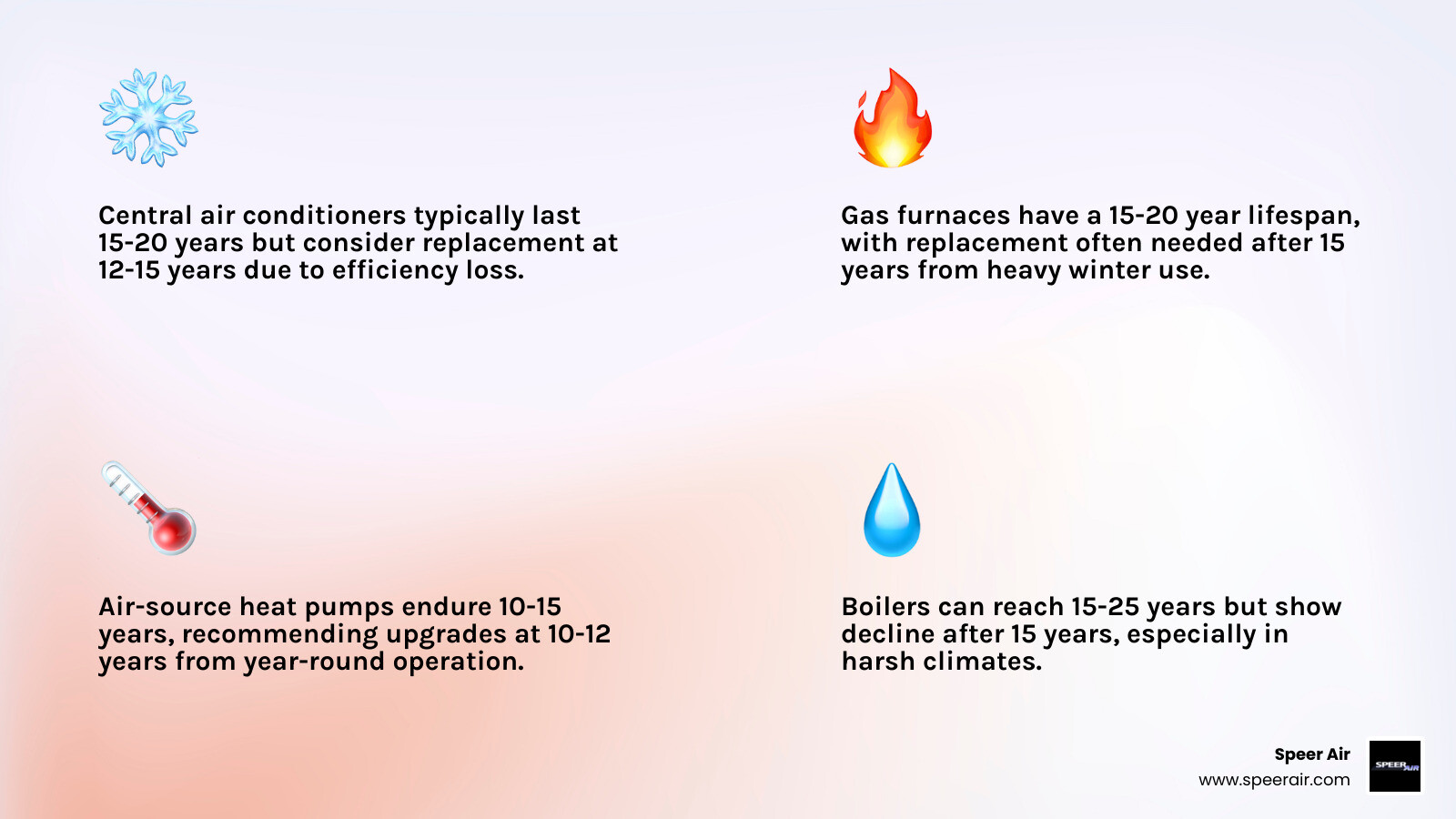
| Equipment Type | Typical Lifespan | Consider Replacement At |
|---|---|---|
| Central Air Conditioner | 15-20 years | 12-15 years |
| Gas Furnace | 15-20 years | 15+ years |
| Air-Source Heat Pump | 10-15 years | 10-12 years |
| Boiler | 15-25 years | 15+ years |
| Ductless Mini-Split | 15-20 years | 15+ years |
If your system is hitting those “consider replacement” ages and showing signs of trouble — rising energy bills, uneven temperatures, or frequent breakdowns — it’s time to take a serious look at replacement rather than another repair.
Nearly one in three homeowners faces a major HVAC breakdown before their system even reaches its expected lifespan. For Northern New Jersey homeowners, that reality hits especially hard. The region’s humid summers and freezing winters push heating and cooling equipment harder than in milder climates, shortening the window between “running fine” and “failing at the worst possible moment.”
The truth is, an older HVAC system doesn’t always announce its decline loudly. It tends to quietly drain your wallet through higher energy bills and creeping repair costs — until one day it stops working entirely, usually during a July heat wave or a January cold snap.
In this guide, we’ll walk you through everything you need to know: how to find your system’s age, what the warning signs look like, and how to decide whether a repair still makes sense or whether replacement is the smarter move.
Understanding the Typical Lifespan of Heating and Cooling Equipment
When we talk about the lifespan of your home’s comfort system, it is important to realize that not all units are created equal. Different technologies face different levels of mechanical stress. For instance, a furnace only works hard during the winter, while a heat pump works year-round to provide both heating and cooling.
Central Air Conditioners
Modern central air conditioning units are generally designed to last between 15 and 20 years. However, the Department of Energy notes that by year 10, many systems begin to operate at only 80-85% of their original efficiency. In our experience across Northern New Jersey, units older than 12 years often start showing the “slow bleed” of frequent minor repairs.
Gas Furnaces
Furnaces are the workhorses of the New Jersey winter. On average, a well-maintained gas furnace can last 15 to 20 years, though some high-quality models can stretch to 25 or 30 years under perfect conditions. However, the efficiency of older furnaces often falls below 80% AFUE, meaning a significant portion of the fuel you pay for is literally going up the chimney.
Air-Source Heat Pumps
Because heat pumps provide both heating and cooling, they accumulate “mileage” much faster than single-season units. Their compressors log between 2,000 and 3,500 operating hours per year. Consequently, they have a shorter performance window, typically averaging 10 to 15 years.
Boiler Durability
Boilers are often the longest-lasting components in a home’s HVAC arsenal. A cast-iron boiler might serve a home for 20 to 35 years. However, older boilers are prone to metal fatigue and scale buildup, which can drastically reduce their ability to transfer heat. If you are noticing leaks or strange metallic clanging, it might be Time For Boiler Replacement In Rockaway.
Ductless Mini-Splits
These systems are highly efficient and typically offer a lifespan of 15 to 20 years. Because they don’t rely on ductwork, they avoid the efficiency losses associated with leaky vents, but the indoor air handlers do require diligent cleaning to reach that 20-year milestone.
How Old Is Too Old for an HVAC System?
The question of how old is too old for an hvac system often comes down to a combination of age, reliability, and technological obsolescence. As of April 2026, the standards for home comfort have changed significantly compared to even a decade ago.
The 15-Year Threshold
For most residential systems, 15 years is the “red zone.” At this point, the risk of a major component failure—like a cracked heat exchanger or a seized compressor—increases exponentially. Statistics show that failure risks are low for the first eight years but become “very high” once a system passes the 15-year mark.
Efficiency Degradation and Modern Standards
Older systems are often “energy hogs.” A system that was rated at 13 SEER when it was installed in 2010 might only be performing at a SEER of 9 or 10 today due to coil fouling and component wear. Modern SEER2 requirements ensure that new installations are significantly more efficient, often reducing energy consumption by 20% to 40% compared to units from the early 2000s.
The Refrigerant Factor
If your air conditioner was installed before 2010, it likely uses R-22 refrigerant (often called Freon). The EPA prohibited the production and import of R-22 in 2020. This means that if an old unit develops a leak today, the cost of the remaining recycled refrigerant is astronomical. In many cases, a single refrigerant recharge on an R-22 system can cost nearly as much as a significant down payment on a new, eco-friendly unit. If you are seeing these costs mount, it is a clear Sign Hvac System Is Ready For An Upgrade.
Determining how old is too old for an hvac system using the $5,000 Rule
A common economic heuristic used by professionals is the Rule of 5,000. To use this, multiply the age of your system by the cost of the repair quote. If the total exceeds $5,000, replacement is usually the smarter financial move.
- Example A: A 12-year-old system needs a $500 repair. (12 x 500 = 6,000). Replace.
- Example B: A 5-year-old system needs a $300 repair. (5 x 300 = 1,500). Repair.
This logic accounts for the fact that investing significant money into an old, out-of-warranty system is often “throwing good money after bad.” If you’re facing a steep bill, our team can help with Hvac Repair Rockaway Nj or provide an honest assessment of whether it’s time to move on.
Why 15 years is often how old is too old for an hvac system in Northern New Jersey
Our local climate in places like Morris and Passaic Counties is particularly brutal on HVAC equipment. We experience high humidity in the summer, which causes outdoor coils to corrode faster, and freezing winters that require heating systems to run almost non-stop. This operational stress means that a system in New Jersey often reaches its “mechanical limit” sooner than a system in a more temperate zone. If your heater is struggling to keep up with a Sussex County blizzard, you should look into Heating Replacement Rockaway Nj.
Key Indicators Your Aging System Needs Professional Attention

Age isn’t the only factor. Sometimes a 12-year-old system acts like it’s 30. Watch out for these Warning Signs Of An Aging Home Boiler System or furnace:
- Uneven Temperatures: If the upstairs is a sauna while the living room is an icebox, your system’s blower motor or ductwork may be failing to distribute air effectively.
- Strange Noises: Rattling, banging, or screeching usually indicates worn-out bearings, loose belts, or a failing compressor.
- Rising Utility Bills: If your energy usage hasn’t changed but your bills are climbing, your system is working harder and longer to achieve the same results.
- Frequent Cycling: A system that turns on and off every few minutes (short-cycling) is under immense strain and is likely nearing a total breakdown.
- Poor Air Quality: Aging systems often struggle with humidity control and can become breeding grounds for dust and allergens, leading to “sick building syndrome” symptoms like respiratory irritation.
Repair vs. Replace: Making the Right Decision for Your Home
Deciding between a patch-up and a total overhaul is a big step. Beyond the $5,000 rule, many homeowners use the 50% Rule: if a single repair costs 50% or more of the price of a new system, you should almost always replace it.
Safety Risks: The Hidden Danger
The most critical reason to replace an old heating system is safety. In aging gas furnaces and boilers, the heat exchanger—the component that keeps combustion gases separate from your breathing air—can develop stress cracks. These cracks can leak carbon monoxide into your home. Because CO is odorless and colorless, this is a life-threatening risk. If a technician discovers a cracked heat exchanger, the system must be shut down immediately. We can help you determine When Should You Replace Your Furnace Or Boiler to avoid these hazards.
Obsolete Parts
As systems age, manufacturers stop producing replacement parts. We’ve seen cases where a perfectly “fixable” unit had to be scrapped simply because a specific control board or motor was no longer available. When parts become obsolete, you are essentially one small breakdown away from a total system loss. Proactive Ac Replacement Rockaway Nj allows you to choose a new system on your own timeline, rather than in an emergency.
Maximizing Performance and Determining Your Unit’s Age
Don’t know how old your unit is? You can usually find the manufacture date hidden in the serial number on the metal “nameplate” attached to your outdoor AC or indoor furnace.
- Locate the nameplate (usually on the side of the unit).
- Find the Serial Number.
- Look for a date code. For many brands, the first four digits represent the week and year (e.g., “1214” would mean the 12th week of 2014).
If you can’t decode it, just snap a photo and show it to us during your next service call.
The Role of Installation and Maintenance
The “design life” of an HVAC system assumes it was installed perfectly and maintained annually. A high-end unit installed poorly—with undersized ducts or incorrect refrigerant levels—will die years sooner than a mid-range unit installed by experts. This is why Choosing Your Hvac Contractor is the most important decision you’ll make for your home’s long-term comfort. At Speer Air, our Hvac Installation Services Available In Rockaway ensure that your new investment is set up for maximum longevity.
Frequently Asked Questions about HVAC Longevity
Can an HVAC system last 30 years?
It is possible, but rare. Some cast-iron boilers and high-quality furnaces can reach the 30-year mark if they were over-engineered and meticulously maintained. However, even if it “still runs,” a 30-year-old system is likely incredibly inefficient, costing you thousands of extra dollars in utilities over its life compared to a modern unit.
What are the risks of keeping an old boiler?
Beyond the safety risks of carbon monoxide, old boilers suffer from “metal fatigue.” The constant expansion and contraction of the metal can eventually lead to a catastrophic leak that floods your basement. Furthermore, older boilers often lack modern safety valves and electronic ignitions, making them less reliable and more dangerous than current models. For safety and peace of mind, consider Boiler Replacement Rockaway Nj.
How does regular maintenance affect the lifespan?
Think of HVAC maintenance like an oil change for your car. Regular tune-ups reduce friction, clean away corrosive dust, and allow technicians to catch small issues (like a $200 capacitor) before they cause a major failure (like a $2,500 compressor). Maintenance also ensures you stay in compliance with manufacturer warranties, which often require proof of professional service to cover part replacements.
Conclusion
Determining how old is too old for an hvac system isn’t just about the number on the nameplate—it’s about your comfort, your safety, and your monthly budget. While saying goodbye to an old system is a significant investment, the peace of mind that comes with a reliable, high-efficiency unit is priceless.
At Speer Air, we’ve been helping Northern New Jersey families stay comfortable since 1900. From our early days in coal and oil to our status today as a NATE-certified Carrier Factory Authorized Dealer and Generac® Dealer, we bring over a century of expertise to every home. Whether you need a quick repair in Morris County or a full system replacement in Sussex County, our team is ready to provide the professional, honest service you deserve.
Don’t wait for your system to fail in the middle of a heatwave. Learn more about our comprehensive HVAC solutions and let us help you decide if it’s time to upgrade your home’s comfort.