

What You Need to Know About Understanding the Parts of Your AC System
Understanding the parts of your AC system is the fastest way to know why your home isn’t cooling properly — and what to do about it. Here’s a quick breakdown of the main components:
The core parts of a central AC system:
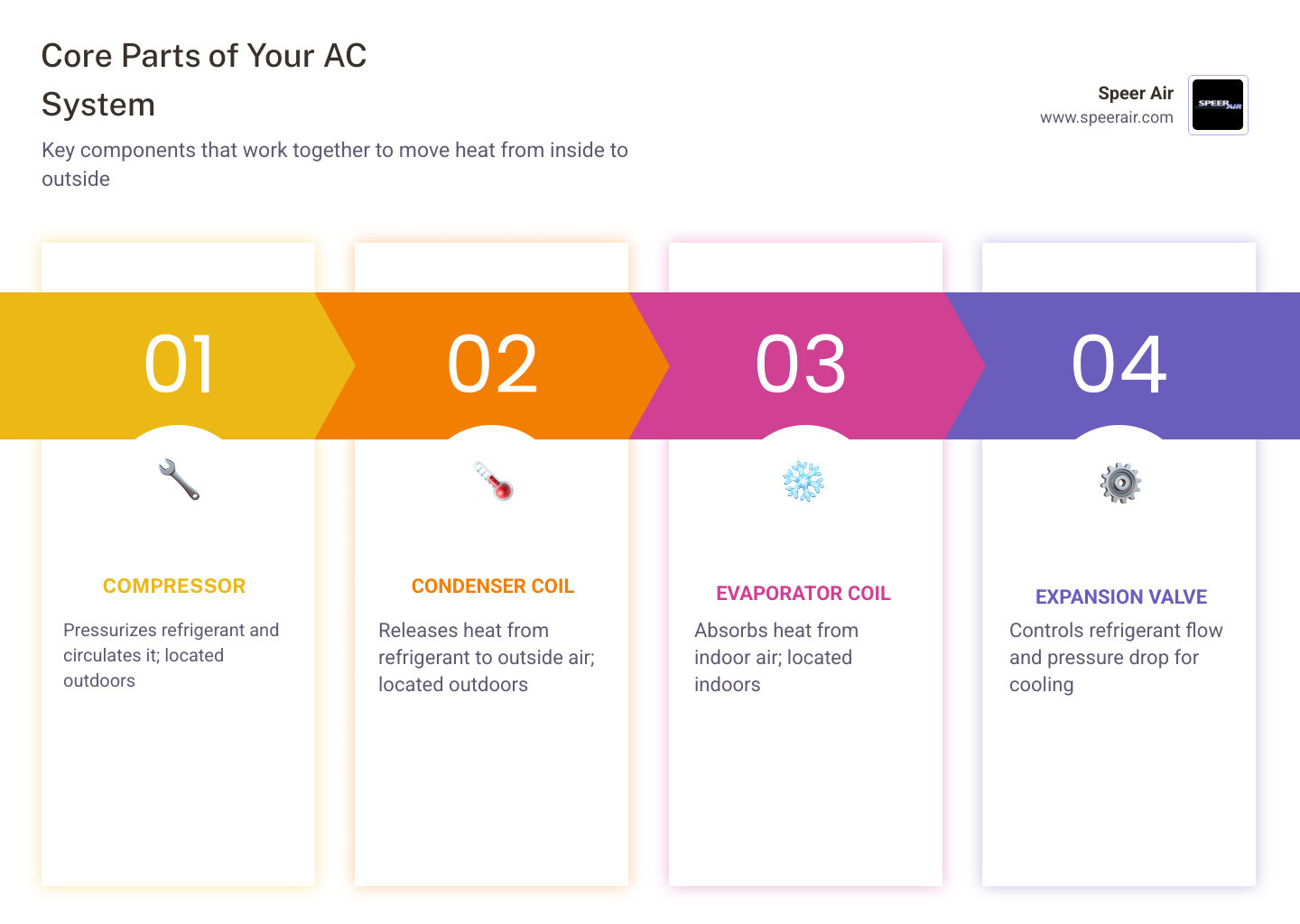
- Compressor — Pressurizes refrigerant and circulates it through the system; located outdoors
- Condenser Coil — Releases heat from the refrigerant to the outside air; located outdoors
- Evaporator Coil — Absorbs heat from your indoor air; located indoors
- Expansion Valve — Controls refrigerant flow and triggers the pressure drop that starts the cooling process
- Blower Fan / Air Handler — Moves cooled air through your home’s ductwork
- Air Filter — Traps dust and particles before air reaches the evaporator coil
- Thermostat — The control center that tells the system when to run
- Ductwork — The network of channels that carries conditioned air to every room
- Refrigerant Lines — Copper tubing connecting the indoor and outdoor units
- Condensate Drain Line — Removes moisture pulled from indoor air during cooling
Your AC doesn’t actually create cold air. It moves heat — pulling it from inside your home and dumping it outside through a continuous refrigerant cycle. Every part of the system plays a specific role in that process, and when one part fails, the whole system feels it.
That’s why knowing what each component does — and what it looks like when something goes wrong — can save you from a surprise breakdown on the hottest day of the year. Whether you’re a homeowner in Rockaway, Denville, or anywhere across Northern New Jersey, understanding your system puts you in control.
Understanding the parts of your ac system: Indoor vs. Outdoor Units
When we talk about central air conditioning, we are usually talking about a “split system.” This name comes from the fact that the system is literally split into two main locations: one half inside your home (typically in the attic, basement, or a dedicated closet) and one half outside (that humming metal box in your yard).
At Speer Air, we’ve been working with these systems in Northern New Jersey since 1900. While the technology has advanced significantly since our early days in the coal and oil business, the fundamental “split” remains the most efficient way to keep a home comfortable. The indoor and outdoor units must work in perfect harmony; if they are mismatched or if one is struggling, the entire cycle breaks down.
The Cold Side: Indoor Components
The indoor portion of your AC is often referred to as the “cold side.” Its primary job is to take the warmth out of your indoor air and send it on a one-way trip outside. The main player here is the air handler or furnace. Inside this unit, you’ll find the blower motor, which acts as the lungs of the system, pulling air from your rooms through the return ducts and pushing it across the chilled evaporator coil.
However, the cold side isn’t just about temperature; it’s also about moisture. As warm air hits the cold evaporator coil, humidity condenses into water droplets, much like a cold soda can “sweats” on a humid July afternoon in Morris County. This water needs a place to go, which is why your indoor unit has a drain pan and a condensate line. If these get blocked, you might face Solutions for AC Drain Line Clogs at Home to prevent water damage to your floors or ceilings. Additionally, if the airflow is restricted by a dirty filter or a mechanical failure, you might find yourself looking for Solutions Frozen Evaporator Coils in AC System.
The Hot Side: Outdoor Components
Step outside, and you’ll find the “hot side” of the system. This unit, known as the condenser, is responsible for taking all that heat absorbed from your living room and releasing it into the outdoor atmosphere. It houses the condenser coil, a large fan, and the most critical component of all: the compressor.
The outdoor fan pulls air across the condenser coils to help dissipate heat. It’s important to keep this unit clear of grass clippings, leaves, and debris. If you hear loud rattling or buzzing coming from this unit, it’s a sign that a component is struggling. Homeowners should Resolve Unusual Heat Pump Sounds quickly to avoid a total system shutdown. The outdoor unit is built to withstand the elements of North Jersey and Eastern PA, but it still needs room to breathe to function efficiently.
The Compressor: Why It Is the Heart of Your AC
If the thermostat is the brain of your AC, the compressor is undoubtedly the heart. It is a powerful mechanical pump that circulates refrigerant throughout the entire system. Without the compressor, the refrigerant would just sit still, and no heat transfer would occur.
The compressor’s job is to take the low-pressure, cool gaseous refrigerant from the indoor unit and squeeze it. This process of pressurization causes the refrigerant’s temperature to skyrocket, turning it into a high-pressure, hot gas. This may seem counterintuitive — why make it hotter? — but it’s necessary because heat naturally moves from warmer areas to cooler areas. By making the refrigerant hotter than the outside air, the system can easily dump that heat outdoors.
Because the compressor does so much heavy lifting, it is the most energy-intensive part of your system. In fact, the compressor is often responsible for up to 70% of your AC’s total energy use. This is why we always emphasize regular maintenance; a struggling compressor will send your Middlesex County or Sussex County energy bills through the roof.
Warning Signs of Compressor Failure
Because the compressor is so vital (and can be the most expensive part to replace), you should never ignore the warning signs that it’s under stress. One of the most common red flags is when the system starts “hard starting,” which sounds like a loud stutter or thud when the unit tries to turn on.
Another major sign is Why AC Might Be Tripping Your Circuit Breaker. If the compressor is drawing too much electrical current because it’s seizing up or overheating, it will trip the breaker to prevent an electrical fire. You might also notice that your vents are blowing warm air even though the fan is running. If you notice the system turning on and off rapidly, you should investigate Why AC Might Be Short Cycling and How to Fix It. Finally, if your outdoor unit sounds like a blender full of rocks, you need to understand Why AC Compressor Might Be Making Loud Noises before the part fails completely.
The Cooling Cycle: Evaporator and Condenser Coils
To truly master understanding the parts of your AC system, you have to understand the “Coil Team.” These two components are the sites where the actual heat exchange happens. They look similar — like a series of copper tubes surrounded by thin aluminum fins — but they have opposite jobs.
| Feature | Evaporator Coil (Indoor) | Condenser Coil (Outdoor) |
|---|---|---|
| Primary Role | Absorbs heat from indoor air | Releases heat to outdoor air |
| Refrigerant State | Changes from liquid to gas (boiling) | Changes from gas to liquid (condensing) |
| Temperature | Very cold | Very hot |
| Common Issue | Freezing over due to low airflow | Getting dirty from yard debris |
Both coils rely on a steady supply of refrigerant. If there is a breach in the copper lines, the system cannot move heat effectively. If you notice a hissing sound or a sudden drop in cooling capacity, you might be facing AC Refrigerant Leak Issues in Your Home, which requires a NATE-certified technician to repair.
How the Evaporator Coil Absorbs Heat
The evaporator coil is usually located inside the air handler, right above the furnace. As the cold, liquid refrigerant enters the coil, the indoor blower fan pushes warm house air over it. The refrigerant is so cold that it acts like a “heat sponge,” soaking up the warmth from the air.
As the refrigerant absorbs this heat, it reaches its boiling point and transitions from a liquid into a gas. This phase change is where the magic happens; it takes a lot of energy to turn liquid into gas, and that energy comes directly from the heat in your room. This process also dehumidifies the air. However, if the moisture doesn’t drain correctly, you’ll need help Fixing Water Leaks from Your AC Unit.
How the Condenser Coil Releases Heat
Once the refrigerant has “captured” the heat from your home, the compressor pumps that hot gas out to the condenser coil. Here, the outdoor fan blows outside air over the coils. Even on a hot 90-degree day in Bergen County, the refrigerant is even hotter (thanks to the compressor), so the heat naturally moves from the coils into the outdoor air.
As the heat leaves, the refrigerant cools down and “condenses” back into a liquid, ready to head back inside and start the process all over again. If the condenser coil is caked in dirt or dog hair, it can’t release heat efficiently. This can lead to the system running longer than it should, which sometimes causes the unit to smell. If you notice a metallic or burning scent, you should learn How to Eliminate Bad Odors Coming from AC.
Supporting Components: Expansion Valves, Fans, and Filters
While the “Big Three” (compressor, evaporator, condenser) get all the glory, the system would fail instantly without its supporting cast. These components regulate the flow, clean the air, and ensure the cooled air actually reaches your bedroom.
Key supporting parts include:
- Expansion Valve: The gatekeeper of refrigerant.
- Blower Fan: The “lungs” that circulate air.
- Air Filter: The “mask” that protects the system and your lungs.
- Thermostat: The “brain” that monitors the temperature.
- Ductwork: The “circulatory system” of the home.
Understanding the parts of your ac system: The Role of the Expansion Valve
The expansion valve (or metering device) is a small but mighty component located right before the evaporator coil. Think of it as a precision nozzle on a spray bottle. It takes the high-pressure liquid refrigerant coming from the outdoor unit and forces it through a small opening, causing a sudden drop in pressure.
This pressure drop causes the refrigerant to get incredibly cold — almost instantly. By regulating exactly how much refrigerant enters the evaporator coil, the expansion valve ensures the system operates at peak efficiency. If this valve fails, your evaporator coil might freeze, or the compressor might get flooded with liquid refrigerant, which can destroy it.
Understanding the parts of your ac system: Why Ductwork and Filters Matter
You can have the most expensive Carrier AC unit in the world, but if your ductwork is leaky, you’re literally throwing money away. A typical home loses an astonishing 20% to 30% of its conditioned air through small gaps, poor connections, and holes in the ductwork. We often see this in older homes in Essex and Union Counties, where ducts may have shifted over decades.
Similarly, the air filter is the simplest part of the system but often the most neglected. Its job is to catch dust before it can coat the sticky, wet evaporator coils. If the filter is clogged, the blower fan has to work twice as hard to pull air through, which can lead to a burnt-out motor. We recommend using filters with an appropriate MERV rating — high enough to catch allergens, but not so restrictive that they “strangle” your system’s airflow.
Common Warning Signs and Maintenance Tips
We’ve been in business for over 120 years, and if there’s one thing we’ve learned, it’s that AC units almost always give you a warning before they quit. The trick is knowing how to listen.
Common signs of component failure include:
- Weak Airflow: Often a sign of a dying blower motor or a severely clogged filter.
- Ice on the Unit: Usually indicates a refrigerant leak or an evaporator coil that can’t “breathe.”
- Puddles of Water: A sign that your condensate drain line is clogged or the drain pan is rusted through.
- Frequent Cycling: If the unit turns on and off every few minutes, the thermostat might be poorly placed, or the system could be oversized.
Understanding the parts of your ac system: Identifying Component Failure
When a specific part starts to fail, it leaves clues. A failing capacitor (which helps the motors start) might cause a humming sound without the fan actually spinning. A failing contactor might cause a “clicking” noise. If you notice your energy bills are spiking even though the weather hasn’t changed, it’s a sign that a component — likely the compressor or the coils — is operating inefficiently.
Weak airflow is particularly frustrating during a North Jersey heatwave. If you feel air coming out of the vents but it’s just a “whisper,” your blower fan might be struggling, or your ductwork could have a major disconnect.
Homeowner Maintenance for Longevity
The good news is that you don’t need a toolbox to keep your AC healthy. Here are the most effective DIY maintenance tasks:
- Change the Filter: Check it monthly, especially if you have pets. Replace it every 30 to 90 days.
- Clear the Perimeter: Keep at least two to three feet of clear space around your outdoor condenser. Trim back shrubs and remove weeds.
- Keep Vents Open: Don’t close off more than 10% of your home’s vents. This creates backpressure that can damage the blower motor.
- Clean the Drain Line: A cup of vinegar down the condensate drain once a year can help prevent algae buildup.
While these steps are great, they don’t replace a professional tune-up. A NATE-certified technician from Speer Air can check refrigerant levels, tighten electrical connections, and clean the coils in ways a homeowner can’t.
Frequently Asked Questions about AC Parts
What is the most expensive part of an AC to replace?
The compressor is almost always the most expensive single component. Because it is the “heart” of the system and requires specialized labor and refrigerant handling to replace, many homeowners choose to replace the entire outdoor unit (or the whole system) if the compressor fails out of warranty.
How often should I change my air filter in April 2026?
By April 2026, we’ll be right in the middle of the spring allergy season in New Jersey and Pennsylvania. You should check your filter every 30 days. If you see a gray layer of dust or pet dander, change it immediately. Maintaining high airflow is essential for the health of your evaporator coil and blower motor.
Why is my AC blowing warm air?
This is usually caused by one of three things: a thermostat set to “Heat” or “Fan Only” by mistake, a failed compressor that isn’t pumping refrigerant, or a refrigerant leak. It can also happen if the outdoor condenser coil is so dirty that it can’t release heat. Check your thermostat settings first, then check your circuit breaker. If those are fine, it’s time to call in the pros.
Conclusion
Understanding the parts of your AC system isn’t just for technicians; it’s for every homeowner who wants to protect their investment and stay comfortable. From the powerful “heart” of the compressor to the “lungs” of the blower fan, every piece must work together to fight the humidity and heat of a Northern New Jersey summer.
At Speer Air, we take pride in our deep roots in the community, serving areas from Rockaway and Denville to the Poconos. As a Carrier Factory Authorized Dealer with over a century of experience, we have the expertise to diagnose and repair all major brands of HVAC equipment. Whether you need a simple filter advice or a complex compressor replacement, we are here 24/7 to ensure your home remains a sanctuary.
Don’t wait for a total breakdown to learn about your system. Schedule your professional AC service in Rockaway today and let us ensure your “Big Three” are in top shape for the season ahead.