

Why the Advantages of a Multi-Generational Local Business Matter More Than Ever
The advantages of a multi generational local business are real, measurable, and surprisingly underappreciated — especially in a world obsessed with the next big startup or tech unicorn.
Here’s a quick look at what makes these businesses stand out:
- Deep community trust built over decades, not marketing campaigns
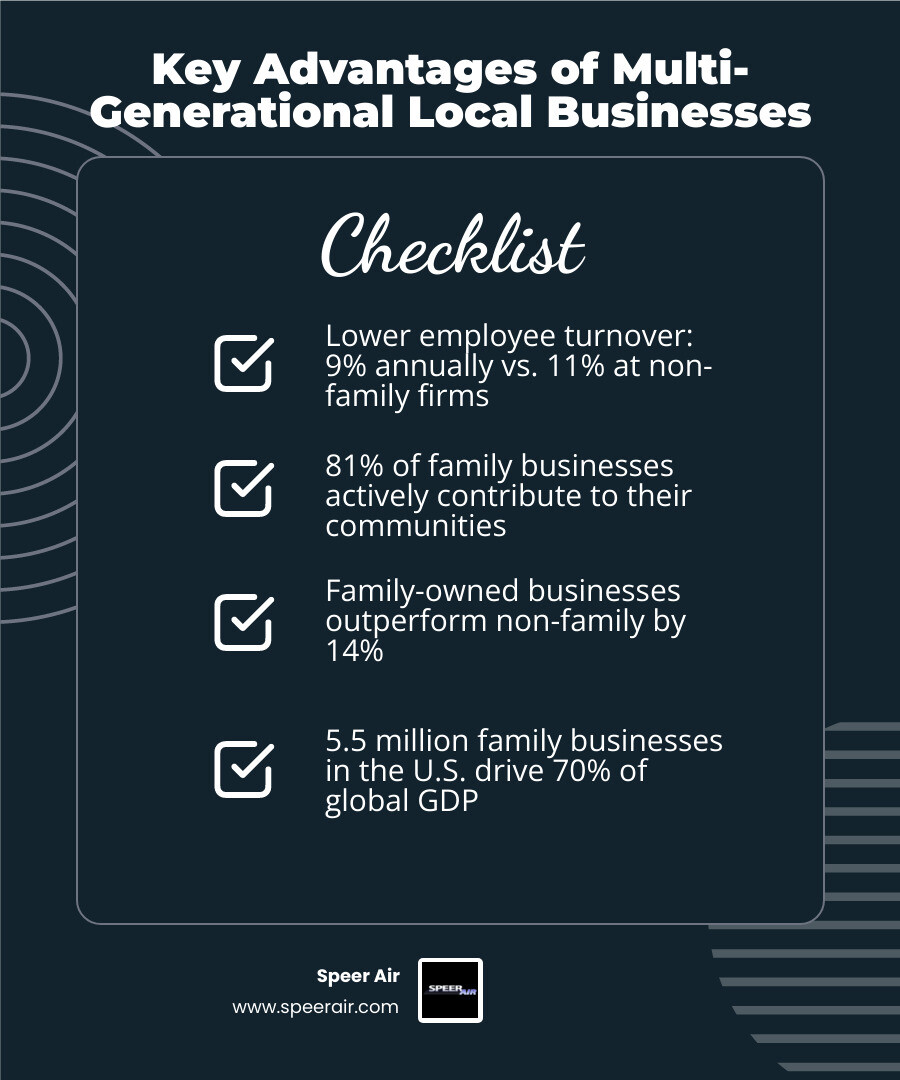
- Lower employee turnover (9% annually vs. 11% at non-family firms)
- Blended expertise — older generations bring wisdom, younger ones bring tech fluency
- Long-term thinking over short-term profit chasing
- Strong local ties — 81% of family businesses actively contribute to their communities
- Operational outperformance — family-owned businesses outperform non-family businesses by roughly 14%
- Authentic customer relationships that turn one-time transactions into lifelong loyalty
There are more than 5.5 million family businesses in the U.S. right now. Together, businesses like these account for over 70% of global GDP and around 60% of global employment as of April 2026. That’s not a niche — that’s the backbone of the economy.
And yet, most people don’t stop to think about why these businesses thrive when so many others come and go. The 80% of Fortune 500 companies from the 1980s that no longer exist didn’t fail because of bad luck alone. They lacked something that multi-generational local businesses quietly build over time: a culture, a purpose, and a people-first foundation that outlasts any single leader.
For homeowners and business owners in Northern New Jersey, working with a company that has that kind of roots isn’t just a nice idea — it’s a practical advantage every time you need reliable service.
Unwavering Trust: The Core Advantages of a Multi Generational Local Business
When you call a local business that has been operating for three or four generations, you aren’t just hiring a service provider; you are tapping into a century of reputation. One of the most significant advantages of a multi generational local business is the “aura of trust” that surrounds it. This isn’t something that can be manufactured by a clever advertising agency in a few months. It is built brick by brick, service call by service call, over decades.
In our experience serving Northern New Jersey and parts of Pennsylvania, we’ve seen how this trust manifests. It’s the difference between a technician who is a stranger and one who remembers installing a furnace for your parents twenty years ago. This legacy of reliability creates a sense of security for the customer. Research shows that family-owned firms often have a strategic foresight that non-family corporations lack; they aren’t looking at the next quarterly earnings report, but rather the next quarter-century.
This long-term vision translates into better community outcomes. Approximately 81% of family businesses contribute to their local community in some way, whether through sponsoring local events, supporting schools, or establishing charitable foundations. This deep-rooted commitment is why we focus so heavily on the specific needs of the neighborhoods who we serve in Rockaway, NJ and beyond.
Furthermore, the personal approach to customer service in these businesses is a rarity in 2026. In an age dominated by automated chatbots and offshore call centers, the multi-generational model prioritizes genuine human interaction. When the family name is on the truck, there is a different level of accountability. You can see this reflected in the Reviews left by neighbors who value that personal touch. We don’t just see a job ticket; we see a neighbor whose comfort is our responsibility.
Blending Tradition with Innovation for Modern Solutions
A common misconception is that “old” businesses are “stuck in their ways.” In reality, the most successful multi-generational businesses stay alive precisely because they know how to balance tradition with innovation. This “bidirectional knowledge” is a powerhouse of productivity.
Think of it as a “network of canals” where knowledge flows in all directions. The older generation provides the “tacit knowledge” — the deep, intuitive understanding of the craft that only comes from decades of hands-on experience. Meanwhile, the younger generation, often referred to as “digital natives,” brings a natural fluency with modern technology, social media, and emerging market trends.
Research indicates that 44% of family businesses prioritize expanding into new markets as a strategic goal. They aren’t just doing what they’ve always done; they are using their stable foundation to take calculated risks on new technology. Here is how those generational strengths typically break down:
| Generational Group | Key Strengths Brought to the Business |
|---|---|
| Traditionalists / Boomers | Deep industry history, crisis management, interpersonal networking, “old school” work ethic. |
| Gen X | Operational stability, bridging the gap between legacy systems and new tech, pragmatic leadership. |
| Millennials | Purpose-driven work, digital integration, focus on sustainability and energy efficiency. |
| Gen Z | Tech-savviness, social media fluency, adaptability to rapid market shifts. |
By blending these perspectives, a local business can offer the best of both worlds. For example, across the many areas we service, we might use high-tech diagnostic tablets to find a problem in seconds, but we rely on the wisdom of our veteran technicians to know exactly how a specific older home’s layout will affect the airflow. This combination ensures that the solution isn’t just modern, but also practical and effective for the long haul.
The Human Element: Stability and Shared Values
One of the most overlooked advantages of a multi generational local business is the stability it provides for its employees. In a corporate environment, layoffs are often the first tool used to balance a spreadsheet. In a family-run business, the “familial bond” often extends to the entire team, regardless of whether they share a last name.
Statistics show that the annual turnover in family businesses is approximately 9%, compared to 11% for non-family corporations. This 2% difference might seem small, but it represents thousands of hours of retained expertise and a much higher level of “psychological safety” for the staff. When employees feel they belong to something bigger than a corporation, their engagement skyrockets.
At Speer Air, we believe that when you Join Our Team, you aren’t just an employee; you are a steward of a legacy that began in 1900. This sense of belonging reduces the “common information effect,” where teams only focus on what everyone already knows. Instead, our diverse age groups feel comfortable sharing unique insights, leading to better decision-making and a more harmonious workplace.
Building Loyalty in a Multi Generational Local Business
Loyalty isn’t just about how long someone stays; it’s about how much they care while they’re there. Interpersonal connections are the primary driver of worker engagement. In a multi-generational setting, younger employees often grow up seeing the work ethic modeled by their elders. They might start by “sweeping the floors” or helping with basic tasks, which instills a sense of pride and responsibility from day one.
This vested interest means that when the local economy faces a downturn, multi-generational businesses are more likely to preserve morale and resist layoffs. They prioritize the people who have helped them build their success. If you are looking for a career where your contribution is valued over the long term, we encourage you to fill out our Online Job Application.
Sustaining Excellence as a Multi Generational Local Business
How do these businesses maintain a 14% performance boost over their non-family counterparts? It comes down to a shared mission and strong family governance. “Learning families” prioritize the education of the next generation, teaching them not just how to run a business, but the ethical standards and values that have kept the company alive for decades.
By establishing a clear vision, these businesses ensure that their entrepreneurial values ripple across generations. This isn’t about unearned inheritance; it’s about earning your place. Many of the most successful family leaders started at the bottom, learning every aspect of the trade. This hands-on approach ensures that the leadership always understands the “front line” of the business. You can learn more about our specific history and values on our About Us page.
Strategies for Long-Term Sustainability and Succession
Despite the clear advantages of a multi generational local business, the path isn’t always easy. There is an old adage: “shirt sleeves to shirt sleeves in three generations.” This refers to the challenge of maintaining wealth and business success beyond the founder’s great-grandchildren. Currently, only about 13% of U.S. family businesses pass to a third generation, and a mere 3% make it to the fourth.
So, how do the survivors do it? The secret lies in “future-proofing” through professionalization and active governance.
- Establishing a Family Council: As a family grows, communication becomes more complex. A family council serves as a cornerstone for preserving unity. It’s a formal place to discuss the business’s direction, educate younger members, and resolve conflicts before they impact operations.
- Effective Succession Planning: This involves more than just picking a new boss. It requires a comprehensive plan that addresses both financial decisions (like gifting equity and estate taxes) and non-financial decisions (like leadership models and the role of non-family executives).
- Continuous Education: Successful multi-generational firms function as “learning families.” They invest in the education of future leaders, ensuring they are qualified to contribute before they take the reins.
- Professional Financial Advisory: Many families measure success by the duration of the business rather than just growth. However, consulting with financial advisors helps maximize investment opportunities and ensures that the business remains a viable “family enterprise” that includes foundations, councils, and diversified assets.
By treating the business as a legacy to be stewarded rather than just a source of income, these companies ensure they stay relevant in an ever-changing market.
Frequently Asked Questions about Multi-Generational Businesses
How do these businesses balance tradition with new technology?
We achieve this through “bidirectional mentoring.” While the older generation preserves the core values and mission, the younger generation leads the charge in embracing digital trends and efficiency-boosting tech. This ensures that innovation is always “driven by tradition,” meaning we only adopt new tools that actually improve the quality of service for our neighbors.
Why is employee turnover lower in family-run local companies?
It’s about the “human element.” Familial bonds often extend to the entire staff, creating a sense of belonging that you won’t find at a massive corporation. We prioritize morale and long-term employment opportunities because we have a vested interest in the success of our team members. When our employees are happy and secure, they provide better service to our customers.
What defines a successful multi-generational transition?
A successful transition is one where the mission remains intact even as the leadership changes. This requires effective succession planning, identifying and nurturing talent early, and maintaining a shared mission. It also involves professionalization — bringing in outside experts and financial advisors to ensure the business is run with the same rigors as any top-tier corporation.
Conclusion
The advantages of a multi generational local business are what keep communities like ours in Northern New Jersey thriving. Since 1900, Speer Air has been a fixture of the local landscape, providing residential and commercial HVAC services, as well as generator installation and maintenance.
Our longevity isn’t a matter of luck; it’s the result of a deep-seated commitment to our neighbors in Bergen, Morris, Essex, and all the counties we serve. As a Carrier Factory Authorized Dealer and a Generac® Dealer with NATE-certified technicians, we combine the weight of industry-leading certifications with the heart of a local family business.
Whether you need a quick repair or a full system replacement, you can trust that we are building for the next century, not just the next service call. Experience the difference that 126 years of dedication makes.