

Is It Time to Fix or Replace Your HVAC System?
Knowing when to repair vs replace your HVAC system can save you thousands of dollars and a lot of frustration. For Northern New Jersey homeowners, where summers get humid and winters bring brutal wind chills, your heating and cooling system isn’t optional — it’s essential.
Most homeowners face this decision at the worst possible moment: the AC quits during a July heat wave, or the furnace goes silent on a cold January morning. In that moment of stress, it’s easy to make a rushed call that costs you more in the long run.
Here’s a quick-reference guide to help you decide:
Repair your HVAC system if:
- The system is less than 10 years old (AC/heat pump) or under 15 years old (furnace)
- The repair cost is less than 30% of the cost of a full replacement
- The system has a clean repair history and is still under warranty
- Energy bills have stayed consistent and comfort has been good
- The issue is isolated — such as a blown capacitor or a faulty thermostat
Replace your HVAC system if:
- The system is 15+ years old and showing repeated breakdowns
- The repair cost multiplied by the system’s age exceeds $5,000 (the “$5,000 Rule”)
- The repair cost exceeds 50% of what a full replacement would cost
- Energy bills have been climbing steadily and the system uses outdated R-22 refrigerant
- There are safety concerns such as a cracked heat exchanger or carbon monoxide risk
- You’ve needed three or more repairs in the past three years
The sections below walk through each of these factors in detail so you can make a confident, well-informed decision.
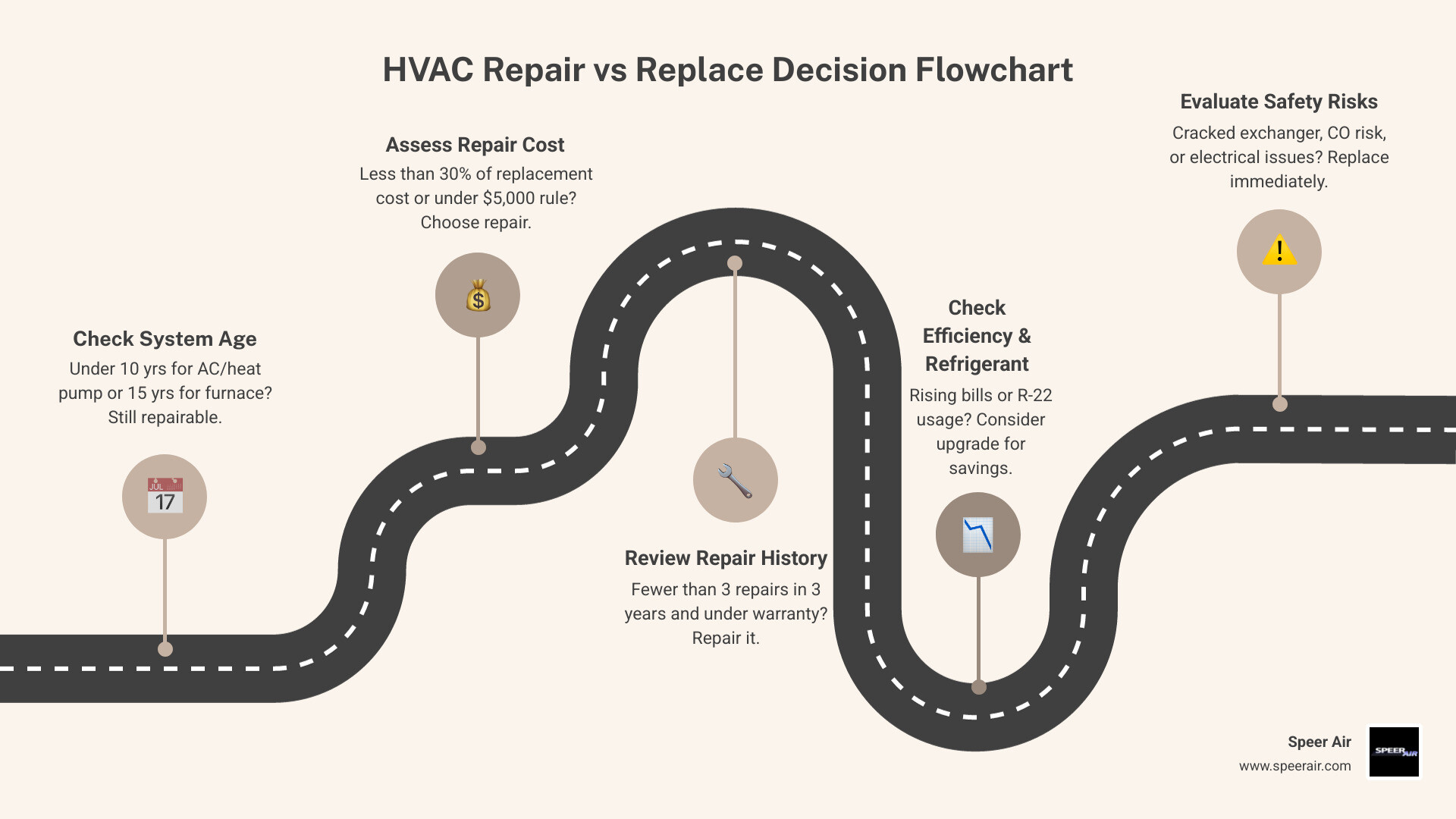
Key Indicators for Choosing When to Repair vs Replace Your HVAC System

When we visit homes in Morris County or Sussex County, we often see systems that are “limping along.” The homeowner is caught in a cycle of paying for service calls every few months, hoping to squeeze one more season out of an aging unit. While we love seeing our customers, we also want you to make the smartest financial choice for your household.
The first thing we look at is the manufacture date. If your air conditioning unit is older than 10 years or your furnace has surpassed the 15-year mark, it is officially in the “consider replacement” zone. While some well-maintained systems can last 20 years, they often become significantly less efficient as they age. Internal components naturally wear down, and the technology inside a unit from 2010 simply cannot compete with the high-efficiency standards of May 2026.
Frequency of breakdowns is another major red flag. One repair every few years is normal maintenance. However, if you’ve had three or more repairs in the last three years, your system is likely entering a stage of “systemic decline.” This is where one part failing puts stress on another, leading to a domino effect of costly service visits. At this point, you aren’t just paying for repairs; you’re paying for the “privilege” of keeping an unreliable machine.
Energy efficiency is the silent factor. You might not notice your system is struggling until you look at your utility bills. If your cooling costs are rising even though the weather hasn’t been unusually hot, your system is working harder to achieve the same results. For more detailed red flags, check out our guide on Signs HVAC System Is Ready for an Upgrade and learn more about Is Your HVAC Over the Hill? Knowing When to Say Goodbye.
Applying the $5,000 Rule to Your Decision
In the HVAC industry, we use a simple mathematical formula to help take the emotion out of the decision. It’s called the $5,000 Rule.
To use it, you multiply the age of your system by the estimated cost of the repair.
- If the result is less than $5,000, repair is usually a sound investment.
- If the result is more than $5,000, you should strongly consider replacement.
Let’s look at two real-world examples:
- Scenario A: You have an 8-year-old AC unit that needs a $400 repair (like a capacitor or fan motor).
- Calculation: 8 (years) x $400 (repair) = $3,200. Since this is under $5,000, we would recommend the repair.
- Scenario B: You have a 14-year-old furnace that needs a $500 blower motor replacement.
- Calculation: 14 (years) x $500 (repair) = $7,000. Because this exceeds the $5,000 threshold, your money is better spent on a new, high-efficiency unit.
This rule works because it accounts for the “residual value” of the system. Investing $500 into a brand-new system makes sense; investing that same $500 into a machine that is already at the end of its life is like putting a new transmission into a car with 300,000 miles on it.
Understanding the 50% Rule for Major Components
While the $5,000 rule is great for minor to mid-range repairs, the 50% Rule applies when you’re facing a catastrophic failure of a major component, such as a compressor or a heat exchanger.
If the cost of a single repair exceeds 50% of the value of a brand-new system, replacement is almost always the better path. Major component failures on older systems often signal that the rest of the unit isn’t far behind. Furthermore, a new system comes with a fresh manufacturer warranty, whereas a repair only warrants the specific part replaced.
When we perform a Complete HVAC Replacement Northern NJ, we ensure that the new system is perfectly matched to your home’s ductwork and size requirements. Mismatched parts—like putting a new outdoor unit with a 20-year-old indoor coil—can lead to early breakdowns and poor efficiency. You can explore our options for HVAC System Replacement to see how modern technology can transform your home comfort.
Evaluating System Performance and Efficiency
Efficiency isn’t just a buzzword; it’s a direct reflection of your monthly budget. In May 2026, the standards for efficiency are higher than ever. If your current AC has a SEER (Seasonal Energy Efficiency Ratio) rating of 10 or less, you are essentially throwing money out the window.
Switching from an older SEER 9 unit to a modern SEER 14 (or higher) model can reduce your energy consumption by more than 35%. If you opt for an ENERGY STAR-certified model, you can save an additional 15% on top of that. For heating, we look at the AFUE (Annual Fuel Utilization Efficiency) rating. Older furnaces might only be 60-70% efficient, meaning 30-40 cents of every dollar you spend on fuel is literally going up the chimney. Modern units can reach 95-98% efficiency.
If you’re wondering When Should You Replace Your Furnace or Boiler?, look at your utility bills from the last three winters. If they are creeping up despite similar usage patterns, your system’s heat exchanger or burner assembly is likely losing its effectiveness. Our Rockaway HVAC Replacement Guide provides a deep dive into how Northern NJ weather affects these efficiency ratings.
Impact of Outdated Refrigerants Like R-22
If your air conditioner was manufactured before 2010, there is a high chance it uses R-22 refrigerant (often called Freon). Due to environmental regulations, R-22 has been phased out because it depletes the ozone layer.
In 2026, finding R-22 is becoming nearly impossible, and the cost for a single recharge can be astronomical. If your older unit has a refrigerant leak, we almost always recommend replacement. Repairing an R-22 system is like trying to find parts for a car that hasn’t been made in 40 years—it’s expensive, inefficient, and ultimately a temporary fix. Modern systems use eco-friendly refrigerants like R-410A or the even newer R-454B, which are more efficient and better for the planet.
Comfort Issues and Airflow Problems
Sometimes the decision isn’t about a total breakdown; it’s about your quality of life. Are some rooms in your house freezing while others are sweltering? Does your house feel humid even when the AC is running? Is the unit so noisy that you have to turn up the TV when it kicks on?
These are all signs that your system is no longer sized correctly for your home or that its internal blowers and coils are failing. Newer systems with variable-speed technology can provide much better humidity control and consistent temperatures by running at lower speeds for longer periods. If you’re experiencing these frustrations, see How We Handle HVAC Repair in Rockaway to understand how we diagnose these complex airflow issues.
Safety Concerns and Immediate Replacement Triggers
There are certain scenarios where the “repair vs replace” debate ends immediately because safety is at stake. Your HVAC system involves high-voltage electricity, combustible gases, and the management of carbon monoxide (CO).
The biggest safety red flag is a cracked heat exchanger in a gas furnace. The heat exchanger is the metal wall that separates the burning gas from the air being blown into your home. If it cracks, carbon monoxide can leak directly into your living space. Because CO is odorless and colorless, this is a life-threatening situation. If we find a cracked heat exchanger during an inspection, we are required to shut the system down for your safety. In an older unit, replacing a heat exchanger is rarely cost-effective, making a full replacement the only logical choice.
Similarly, persistent electrical issues or a “systemic decline” that leads to scorched wiring can pose a fire hazard. If you smell something burning or see sparks, shut the system off and call for HVAC Repair Rockaway NJ immediately.
When to Repair vs Replace Your HVAC System for Safety
Minor issues like a faulty thermocouple or a dirty pilot light are safe and easy to repair. However, if your system has a history of gas leaks or if you notice a yellow, flickering flame instead of a steady blue one, you have a combustion problem.
We take these issues seriously. Our NATE-certified technicians are trained to identify Common Heating Repair Issues and Solutions before they become emergencies. If you’re in Morris County, our Best Heating Repair Rockaway NJ Guide can help you identify when a noise or a smell is a sign of a dangerous malfunction.
Long-Term Benefits of Upgrading Your Home Comfort System
While the initial investment in a new system is significant, the long-term financial picture is often much brighter than homeowners realize. Between energy savings, tax incentives, and increased property value, a new system often pays for itself over several years.
| Feature | Older Units (10-15+ Years) | Modern High-Efficiency Models (2026) |
|---|---|---|
| Energy Consumption | High (SEER 8-10) | Low (SEER2 14-22+) |
| Monthly Savings | N/A | 20% to 40% Reduction |
| Refrigerant | R-22 (Expensive/Phased Out) | R-410A / R-454B (Eco-friendly) |
| Sound Levels | Loud / Disruptive | Whisper-Quiet Operation |
| Warranty | Expired | 10-Year Parts & Labor |
| Tax Credits | None | Up to $2,000 (Inflation Reduction Act) |
The Inflation Reduction Act has changed the game for many Northern New Jersey residents. High-efficiency heat pumps now qualify for federal tax credits of up to 30% of the cost, capped at $2,000. When you combine this with local utility rebates and the 20-40% monthly savings on your energy bill, the “math” for replacement becomes very compelling.
Modern Technology and Smart Home Integration
One of the best reasons to replace rather than repair is the leap in technology. Modern systems offer:
- Variable-Speed Motors: Instead of being “all on” or “all off,” these motors adjust their speed to the exact needs of your home, resulting in much lower energy use and quieter operation.
- Zoning Systems: You can finally stop cooling the guest room you never use while keeping your bedroom at the perfect temperature.
- Smart Thermostats: Control your home’s climate from your smartphone anywhere in the world.
- Enhanced Filtration: Newer systems can be equipped with HEPA-grade filters and UV lights to drastically improve indoor air quality, which is a blessing for allergy sufferers in Bergen and Passaic counties.
Frequently Asked Questions about HVAC Repair and Replacement
How long do most HVAC systems last in 2026?
In our local climate—where systems work overtime to battle both freezing winters and humid summers—you can generally expect a lifespan of 15 to 20 years for a furnace or central air conditioner. Heat pumps typically last about 15 years because they operate year-round for both heating and cooling. If a system hasn’t been regularly maintained, that lifespan can drop to 10-12 years.
Is it better to replace the furnace and AC at the same time?
If both units are over 12 years old, the answer is usually yes. Replacing them together saves you significantly on labor costs because our technicians are already on-site and working on the shared components like the blower motor and ductwork. More importantly, it ensures the two units are “matched.” A brand-new high-efficiency AC won’t perform at its peak if it’s forced to work with an old, inefficient furnace blower.
When to repair vs replace your HVAC system if it uses R-22?
Unless the repair is incredibly minor (like a loose wire), we almost always recommend replacement for R-22 systems. The cost of the refrigerant alone is often higher than the value of the unit, and since the refrigerant is phased out, you’re just delaying the inevitable. Investing in a modern system using R-410A or R-454B is the more responsible and cost-effective choice.
Conclusion
Deciding when to repair vs replace your HVAC system doesn’t have to be a guessing game. By using the $5,000 rule, checking your system’s age, and keeping an eye on your energy bills, you can make a choice that protects both your comfort and your wallet.
At Speer Air, we’ve been serving Northern New Jersey since 1900. From our early days in the coal and oil business to our current status as a NATE-certified Carrier Factory Authorized Dealer and Generac® Dealer, we have the deep industry roots needed to solve any HVAC challenge. Whether you are in Rockaway, Denville, or anywhere across Morris, Bergen, or Sussex counties, we are here for you with 24/7 emergency service and expert advice.
Don’t wait for a total system failure in the middle of a heat wave. Contact our experts for a professional system evaluation today, and let us help you find the perfect, most efficient solution for your home.